
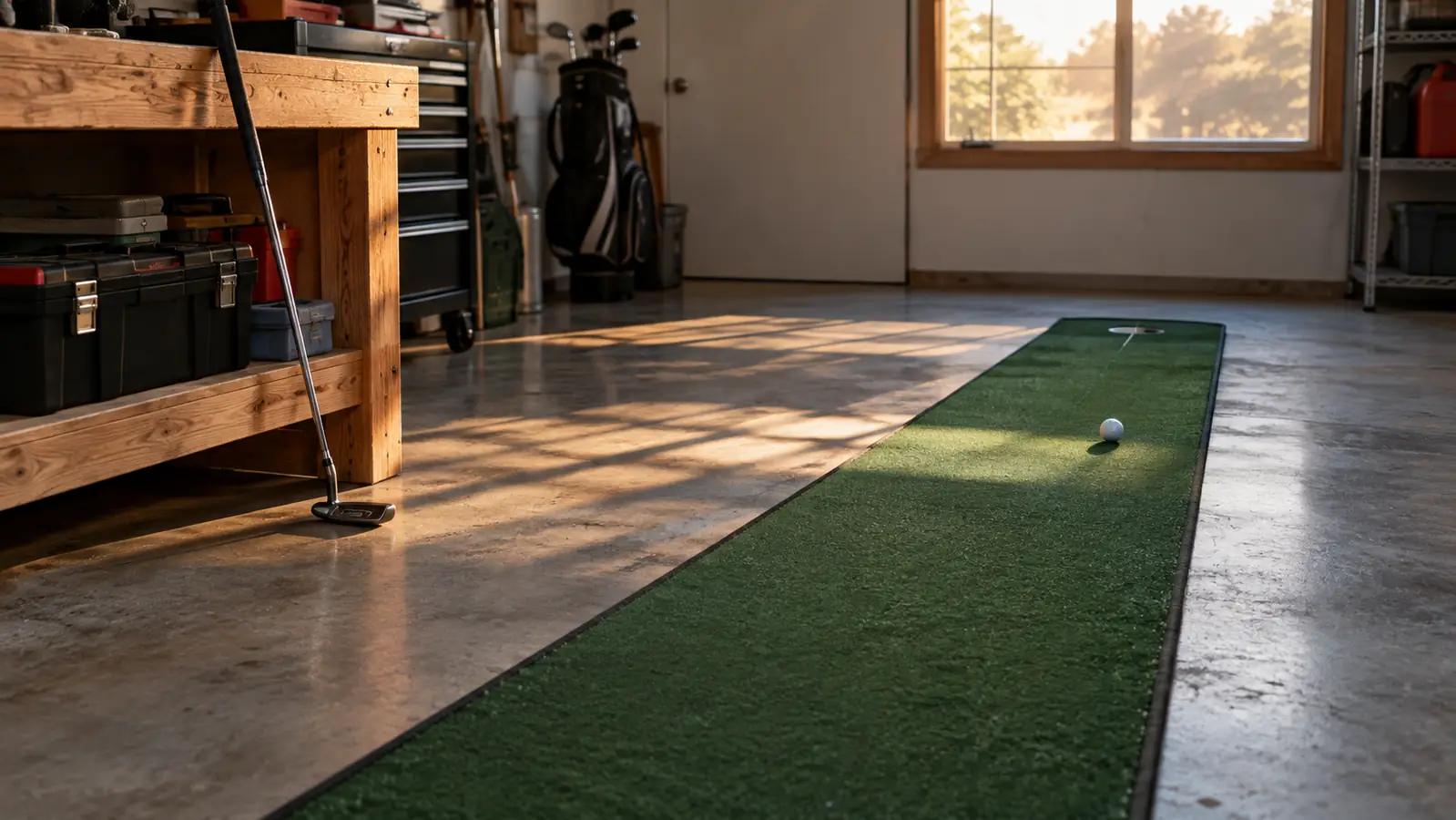
I got serious about putting the same way I got serious about most things in my fifties: slowly, and then all at once. For years the Tuesday group got me with two or three putts a hole, and I kept blaming the putter, the ball, and the greens themselves. The truth was simpler. I practiced putting about twice a month, and twice a month is not practice. So last winter I cleared a corner of the garage, laid down a mat, and started working on six-footers most evenings. Before long I owned two practice greens instead of one, the Putt-A-Bout Par Three and the SKLZ putting green, and I got to compare them honestly. Here is what I found.
The short answer, for anyone who wants it up front: the Putt-A-Bout Par Three is the one I kept out and the one I would buy again. It rolls closer to the practice green at my home course, it stays where you set it, and it has cost less for as long as I have watched the listings. The SKLZ green earns its keep in a couple of genuinely useful ways, mostly the ball return and the printed alignment marks. If those matter more to you than a true roll, it is a fair choice. I will go through the tradeoffs one by one, because the right practice green for you depends on where you practice and what you are actually trying to fix. And I will say this plainly: I expected the fancier mat to win this comparison, and that is not how it played out.
| Putt-A-Bout Par Three | SKLZ Putting Green | |
|---|---|---|
| Putting Feel | Closer to a real club-green roll, a touch slow, honest about your stroke | Fast and slick, fun to stroke, but faster than most real greens |
| Ball Return | Ball drops at the cup and waits for you to walk over | Molded return rolls the ball straight back to your feet |
| Alignment Help | A plain cup. You aim with your eyes and learn your own line | Printed lines and distance marks point straight at the hole |
| Practice Area | Three feet wide, room to set the ball at the edge and practice breaking putts | Slimmer surface, best for straight putts down the middle |
| Stays Put | Heavy foam base sits flat and does not slide mid-session | Lightweight and can drift if you catch it with your foot |
| Portability | Thick slab that wants a permanent corner in the garage | Rolls into a slim tube that tucks into a closet or behind a door |
| Price | The lower-priced option, and it has stayed that way for years | Costs more for the return and the printed guides |
Here is how I tested them, so you know what this comparison rests on. I kept a simple count of makes from three, six, and eight feet, no do-overs, and I switched mats every other week so I could not fool myself into thinking one felt better just because I was used to it. I also took the same putting stroke to the course on Tuesday mornings to see which mat's distance control carried over. That outdoor check is the part most comparisons skip, and it is the part that told me the most.
Where the Putt-A-Bout Wins
The biggest reason the Putt-A-Bout stayed in my garage is the roll. It is not the fastest surface you will ever putt on. The first time you roll a ball on it, especially if you came from a slicker mat, it feels slow, almost heavy. Give it a week and you will notice the pace matches the practice green at my home course, and that is exactly the point. When distance control improves on the mat, it carries over to the course. That carryover is the whole reason to own a practice green, and it is why I reach for this one most evenings. If you are serious about your putting, that honest roll matters more than any printed line.
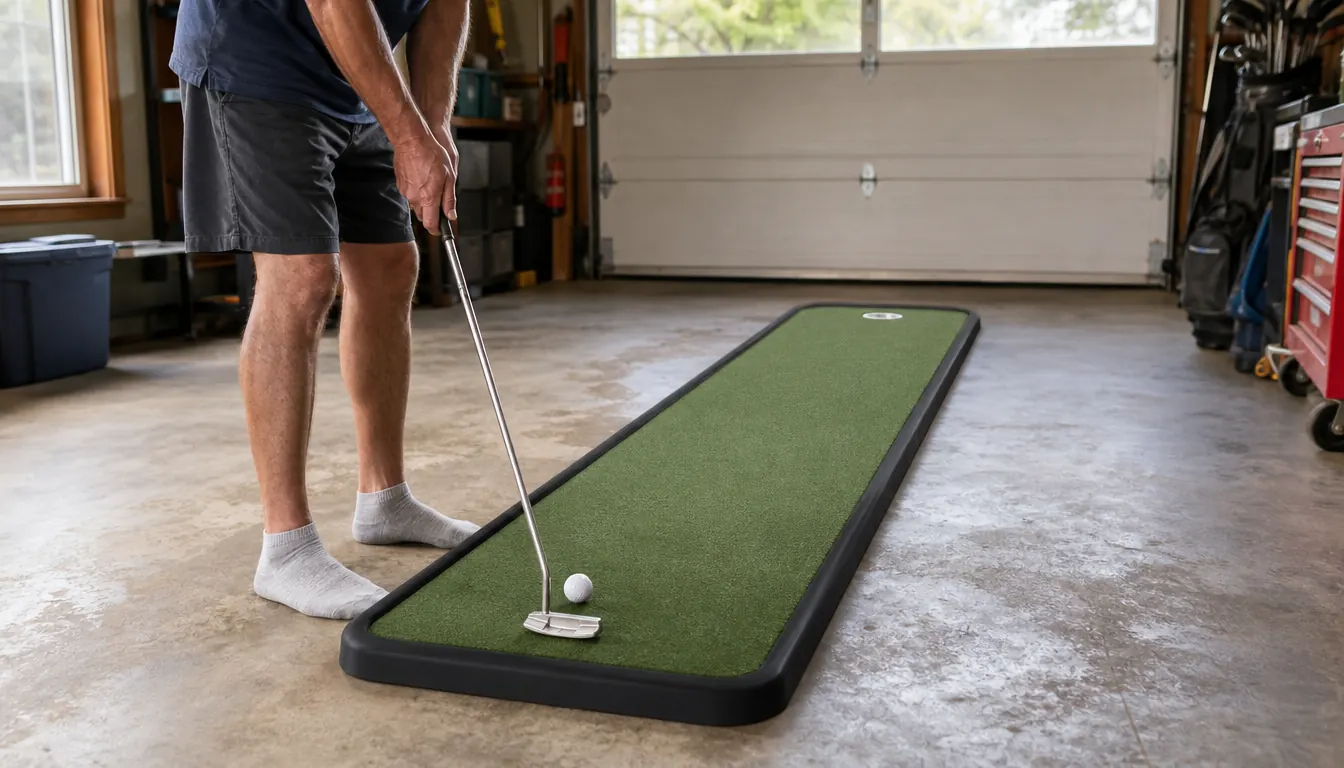
The width is the quiet advantage. At three feet across, the Putt-A-Bout gives you room to set the ball near the edge and work a breaking putt, not just hit straight balls down the middle. The heavy foam base is the other thing I appreciate. It sits flat on a concrete garage floor, stays put when I nudge it with my foot, and still lies flat after a humid summer. A lighter mat slides around halfway through a session, and a sliding mat teaches you nothing.
Then there is the value. The Putt-A-Bout has always been the lower-priced of the two, and it has held that spot for years, which tells you something about how well it sells. You are getting the bigger surface and the steadier base for less money. If you are not sure a practice green will stick in your routine, that is the sensible bet to make first. You can always move up to a fancier green later if the habit sticks.
I also use mine as a chipping target on the grass beside the garage, and it is thick enough to handle the landing. Golfers in my Tuesday group who stop by usually reach for the Putt-A-Bout first, and they all say the same thing: it feels like a green, not a toy. That is the highest compliment a practice mat can get.
After a full year in the garage, the Putt-A-Bout has held up fine. The carpet naps down in the worn spot where the ball rolls past, same as a real green takes foot traffic, and a quick pass with the vacuum brings it back. The foam has not cracked or sagged. For a mat that lives on a concrete floor through a humid South Carolina summer, that counts for a lot.
For full honesty, the Putt-A-Bout is not perfect. It is bulky, and it will never roll up small enough for a closet. The cup sits flat at the far end, so you do not get the satisfying drop of a hole liner. And the slow surface can frustrate a golfer who expects that fast carpet roll. I want you to know that, because no practice green is everything.
Where the SKLZ Green Wins
I will hand the SKLZ green genuine credit on the ball return. The Putt-A-Bout drops the ball into the cup and leaves it sitting there for you to walk over and fetch. The SKLZ rolls it straight back to your feet on its own. When you are working through thirty or forty putts in a row, that saves a surprising amount of bending, and it keeps your rhythm honest. I did not think I would care, and I was wrong. It is a good feature, full stop. It is the feature I would miss most if I went back to a plain mat.
The SKLZ also does a better job of teaching a square putter face. The printed lines and distance marks point straight at the cup, so you can check your setup and your path without setting up a second gadget. The Putt-A-Bout gives you a plain cup and leaves the aiming up to you. For a golfer still building a repeatable stroke, that built-in feedback is worth something real. The SKLZ also rolls up into a much slimmer, lighter tube than the thick foam slab of the Putt-A-Bout. If your practice spot changes week to week, or you need to tuck the mat into a closet after dinner, that portability alone could settle the decision. And in a house with no garage at all, fitting behind the couch is a real advantage.
To be fair, the SKLZ surface is faster and slicker than a real green. Some golfers like that for grooving a confident stroke. I found it made my distance feel too aggressive when I got back outside, which is why it did not unseat the Putt-A-Bout. But the return and the alignment aids are legitimately better, and I say that even though I did not end up keeping the SKLZ as my main mat.
The SKLZ is also the easier sell to a golfer who thinks practice is boring. The ball coming back feels like a small reward, and the printed lines make every putt feel like a drill with a purpose. If a mat has to entertain you into practicing, the SKLZ will do that job better than the Putt-A-Bout. That is not a knock on either mat. It is just the truth about how they work.
The green I kept set up all winter
The Putt-A-Bout Par Three rolls close to a real practice green, stays flat on a garage floor, and has held a fair price for years. That combination is hard to beat.
Amazon Check Today's Price on Amazon →
Who Should Buy Which
Buy the Putt-A-Bout if you have a spot where the mat can live, even just a corner of a basement or garage, and you want the roll to feel like the course. It is the better match for a golfer who trusts feel over printed lines, who does not mind walking three feet to the cup, and who wants a surface that punishes a shaky stroke the way a real green does. It is also the one I would hand to a friend just starting out, because it teaches distance control without any gimmicks in the way.
Buy the SKLZ green if your practice spot changes week to week, if you only get short sessions and want the ball back at your feet without bending, or if alignment guides will actually get you to practice more. It is the smarter pick for an apartment or a small office, and it makes a fine second green for a golfer who already owns the Putt-A-Bout and wants something quick to roll out after dinner.
My honest advice is the same thing I tell the Tuesday group. Buy the green that will actually get used. If a mat that stays out and feels like a real green gets you to the practice stroke, that is the Putt-A-Bout. If you need to pack it away and want the ball to come back on its own, that is the SKLZ. Both are good products. They are just good at different jobs. I practice on the Putt-A-Bout most evenings, and that is the one I would buy again tomorrow. Whichever you choose will pay for itself the first winter it keeps you practicing while the course is closed.
If I had to hand somebody one of these today and could not explain why, I would hand them the Putt-A-Bout Par Three. It is the closer to a real green, the more forgiving of a cluttered garage, and the easier on the wallet, and those three things matter more to me than a ball return. The SKLZ is not a compromise. It is a different tool for a different setup. Buy based on where the mat will live and how you actually practice. Permanent corner, short sessions, want the honest roll: the Putt-A-Bout. Small space, need to pack it up, want the ball back and lines to follow: the SKLZ. Either way, you are practicing more than the golfer who owns neither, and that is the real win.
One last thing worth saying. I have watched golfers buy a cheap mat, use it twice, and declare practice useless. The mat was not the problem in that story. Whatever you pick, leave it out where you will walk past it, because the golf that gets practiced beats the golf that gets planned.
Start with a garage corner and ten minutes a night
The Putt-A-Bout Par Three is the lower-priced, truer-rolling pick of the two, and it has been a steady seller for years. See today's price on Amazon, and if you have any doubt, come back and re-read the parts about the roll. That is the part that matters most.
Amazon Check Today's Price on Amazon →