
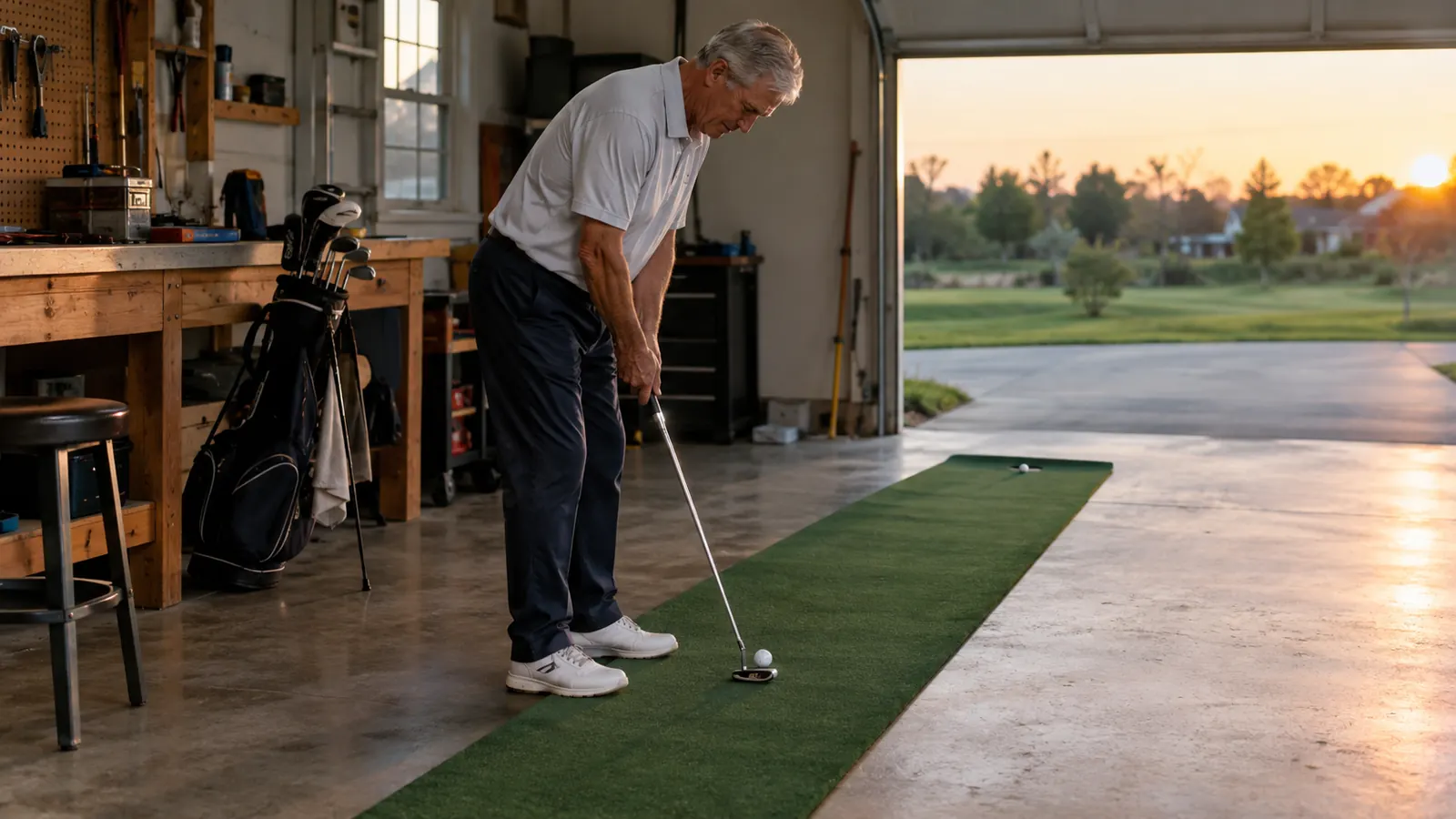
I came to golf at fifty-two, which means I missed the years when your body learns the swing for you. At sixty-one I carry an eighteen handicap, and my Tuesday group knows the honest number behind it: I lose more strokes on the green than anywhere else on the course. Two-putts were a good day. Three-putts were the norm. Then a rainy March and a nine-foot strip of practice surface changed how my evenings looked.
My garage is not fancy. It holds a small practice net for full swings, a workbench with ten years of sawdust ground into it, and a putting mat that came with a gift set somebody gave Karen. That mat was fine for five-footers, but it rolled like carpet, not like the greens at my home course. It rewarded me every time. There was no break to read, no real speed to judge, and no consequence when I left a putt short. I needed something that gave me a read, a break, and a hole that did not hand me a participation trophy. That is exactly what the PUTT-A-BOUT Par Three turned out to be.
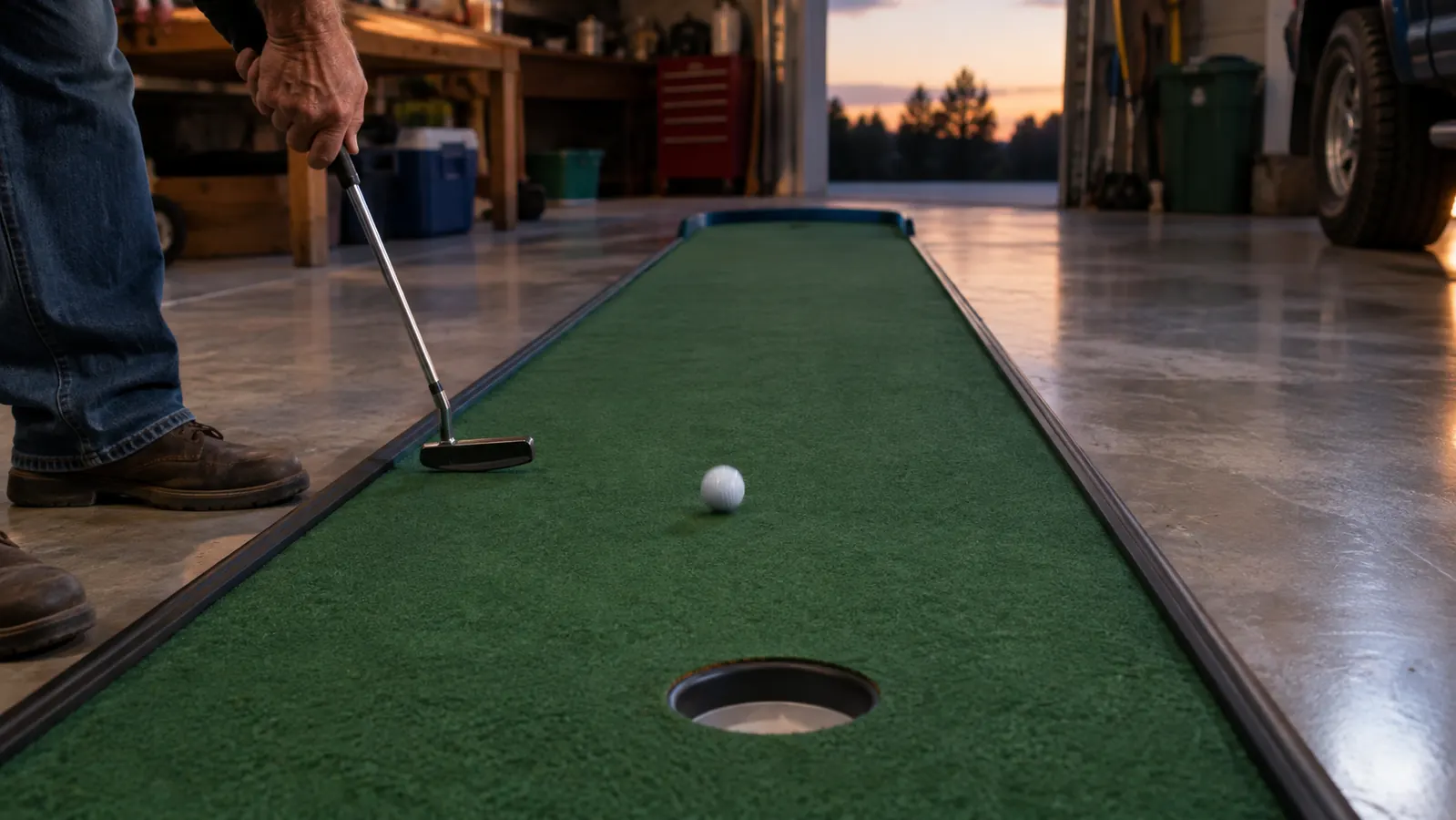
It is three feet wide and nine feet long. It has three holes, one near each end and one in the middle, so you get three different looks from the same stance. A ramp at the back catches the ball and sends it back to you, which means you are not bending over to fetch it after every putt. I unrolled mine on the garage floor on a rainy Tuesday evening and told myself I would give it thirty minutes. I was still out there an hour later, and Karen had to come tell me supper was ready.
Here is what surprised me most. It does not roll like carpet. The surface is firmer and faster than the little mat I had, closer to what I feel under my feet on the greens I actually play. The break reads honest, and the ball keeps its speed better than I expected. You can work a straight five-footer, a breaking eight-footer, and a lag from the far end without moving a thing. The ramp makes a solid clack when a putt drops, and I will not pretend that sound gets old. It does not.
The group noticed before I said a word. On the second dry Tuesday after I started, one of the guys asked if I had taken a lesson. I told him my lesson was a nine-foot strip of practice surface in the garage. He laughed until I drained a twelve-footer for par on the last hole. Then he asked where he could get one, which I took as a fair review.
Ten days of putting in the garage, and my Tuesday group asked if I had taken a lesson.
The Same 3-by-9 Green I Roll Out on Rainy Evenings
If your three-putts look like mine did, this is a plain, honest way to practice at home. It rolls up for storage, the ball comes back to you, and thirty minutes a night is enough to start seeing a difference.
Amazon Check Today's Price on Amazon →I will be straight with you about the tradeoffs, because nobody in this article is being paid to pretend. It is not a putting studio. It is not wide enough to practice the big sweeping curve you might face on a tournament green, and the ball return makes a little clack every time a putt drops in. It takes up floor space while it is unrolled, and you have to wipe the surface down now and then so dust does not slow the roll. None of those are deal breakers for me, but you should know them before you buy.
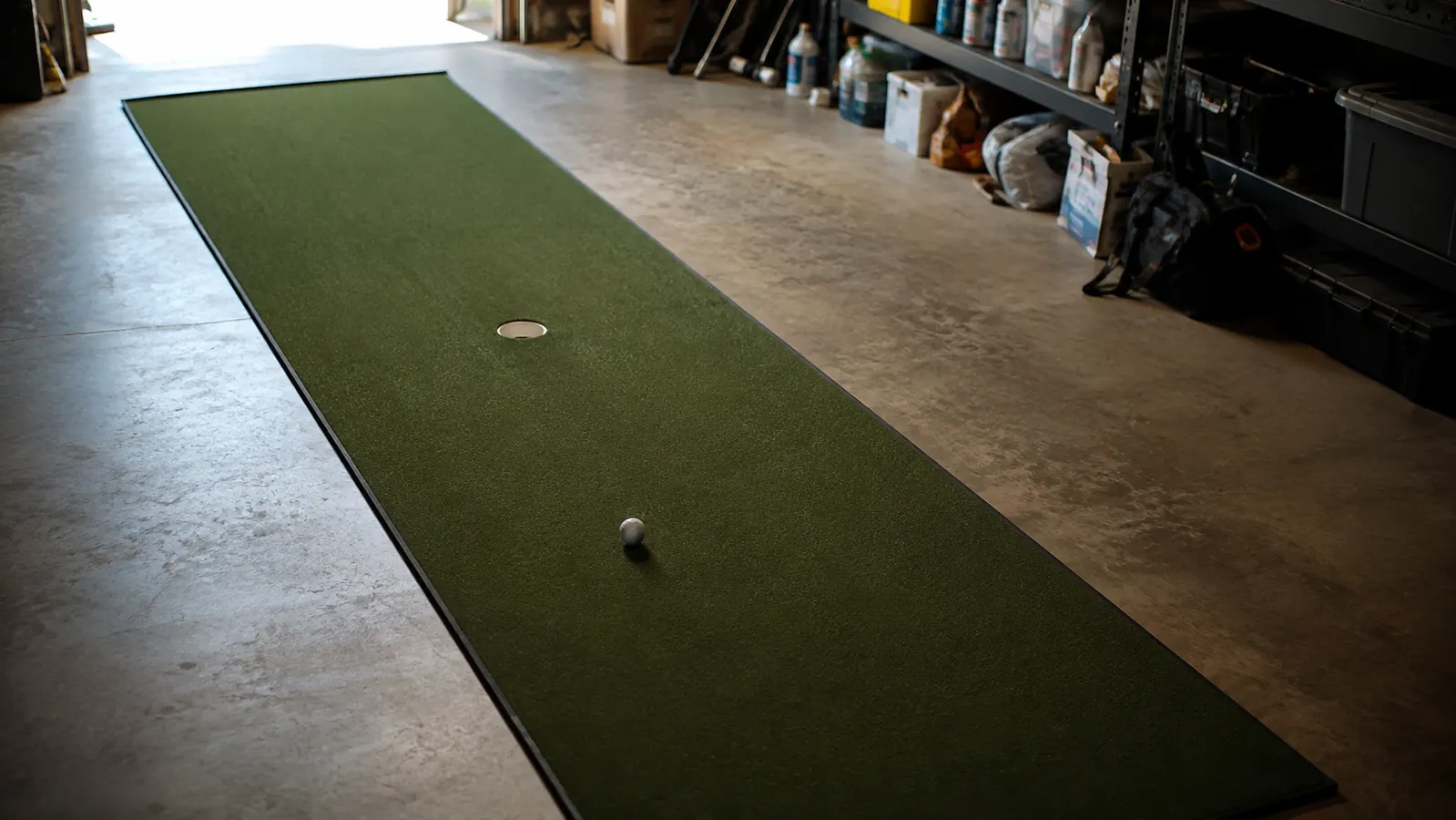
Here is how it fits into my week. On rainy evenings I hit a dozen balls into the practice net, then putt on the PUTT-A-BOUT until Karen calls me in for supper. In the winter it is the whole reason my putting stroke survives, because the course is closed and the range is forty minutes away. On a cold night I can keep my hands busy for an hour without leaving the house. That matters more than people who live in warm places realize.
Karen does not golf, but she has started putting while I clean up the clubs. She says the middle hole is her favorite, and she is better from eight feet than I am, which I will not be discussing further. She also pointed out that the whole thing rolls up and tucks against the wall in about thirty seconds, which is her polite way of saying it would not stay in the house if it did not.
I want to be honest about the score. I am still an eighteen handicap, so I am not going to tell you this green knocked five strokes off my card. It did not. What did happen is that three-putts went down, the short ones I used to lip out started dropping, and I stopped dreading the last three holes on a Sunday. At my level, that is the whole ballgame.
What I'd Tell You If We Were Sitting at My Kitchen Table
If you are a weekend golfer like me, your garage or closet probably already holds a pile of equipment that promised more than it delivered, and I understand not wanting to add to it. So here is my honest counsel. You do not need another gadget tucked in a drawer. You need a place to practice that makes you actually want to practice. For me, that place is a nine-foot strip of PUTT-A-BOUT sitting between the workbench and the door. It will not fix a broken swing, and it will not turn you into a scratch putter overnight. But if you putt ten balls a night for a month, you will show up on Tuesday with a little more confidence, and you will feel the difference before the scorecard does. Set it up, give it a fair month, and let your next round tell you the truth.
Give It a Month of Evenings and Let Tuesday Tell You
The PUTT-A-BOUT Par Three rolls up tight, stores easy, and gives you a real surface to practice on. See it on Amazon and decide for yourself whether it earns a spot in your garage.
Amazon Check Today's Price on Amazon →