
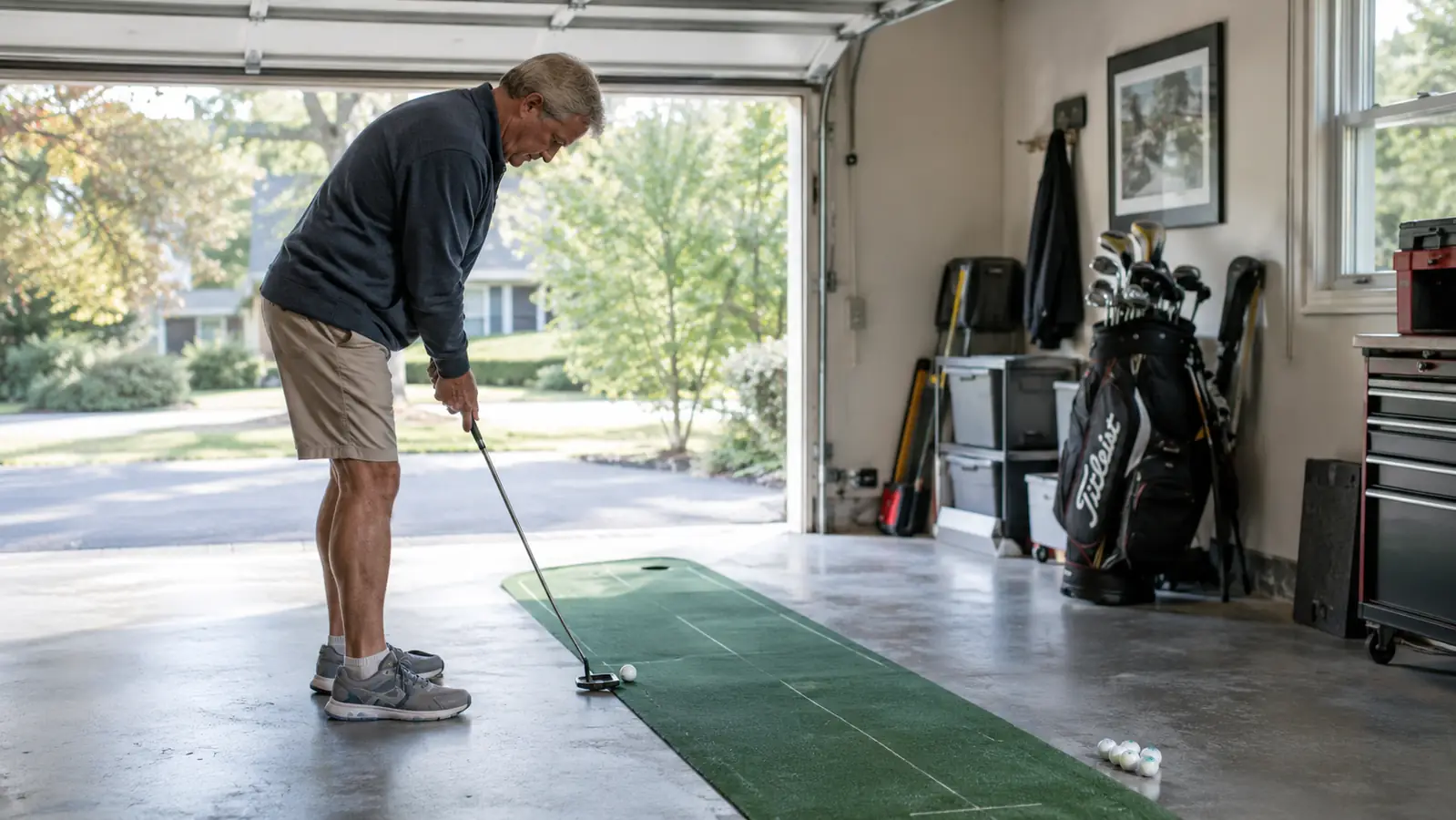
Three-putting is what got me into this. I'm Walt, I'm 61, and I came to golf late, at 52, so I've spent nine years trying to make up for lost time. My handicap sits right around 18, which sounds respectable until you watch me on the greens. The long game is fine. The short game is where I give strokes back, and most of those are three-putts. Last winter I finally got sick of it. The course was closed more than I liked, my Tuesday group was mostly moaning about the cold, and practicing on the living room carpet was worse than not practicing at all, because carpet lies to you. That's what pushed me to the Putt-A-Bout Par Three. It's a 3 by 9 foot putting mat, and it has lived in my garage for the better part of a year. This is the long-term review I wish someone had handed me before I bought it.
The short version is that it does exactly what it says, it has held up better than I expected for the money, and I still use it almost every day nine months later. The longer version is the one worth reading, because there are a couple of honest tradeoffs that nobody mentions in the product listing. I'll get to those in a minute. First, the bottom line, so you know where I land.
The Quick Verdict
For what it costs, the Putt-A-Bout Par Three is the best practice money I've spent since I took up the game. It will not fix your stroke by itself, and it only rolls straight putts. But it gives you a flat, honest surface that holds up for months, and the ball return keeps you practicing instead of fetching. If you three-putt as often as I did, that's worth a lot.
Amazon Check Today's Price →The putting mat that earned a permanent spot in my garage
After nine months of near-daily use, the Putt-A-Bout Par Three is still the first thing I reach for when I want to practice at home. Check today's price and the current reviews on Amazon.
Amazon Check Today's Price on Amazon →How I've Used It
It lives in my garage on the concrete floor, and it takes about two minutes to lay out. The mat is 3 feet wide and 9 feet long, which is enough room for a real putting stroke. Not the kind of desk toy stroke you get on a 2 foot mat. A real stroke, with the putter swinging free and the ball rolling out a full nine feet. My routine is simple. Most evenings I go out there for fifteen or twenty minutes and roll putts from three, five, and seven feet. The cup sits at the far end on a slight rise, and when a putt drops, the ball rolls back down to your feet. That sounds like a small thing. It is not a small thing. You never stop to fetch, so you stay in the rhythm of practicing, and rhythm is what putting actually is.
I keep score in my head, which the old shop teacher in me likes. Ten putts from five feet, count how many drop. In the first couple of weeks I was making four or five. Now it's usually seven or eight. That's not me bragging, because nobody brags about making seven of ten five footers. It's what a flat, predictable surface does for you. You finally get to practice the same putt over and over, which you simply cannot do on a real green, and repetition is what builds the kind of confidence that shows up on the course.
Some nights I only have ten minutes before dinner, and I still go out and roll a dozen putts. The mat does not care if you practice for ten minutes or an hour, and neither does your stroke. What matters is showing up. That's the thing I did not understand for the first few years I played golf. You don't need a course membership and a whole afternoon to get better. You need a flat surface, a putter, and the discipline to use it. This mat makes that discipline easy.
What You're Actually Getting
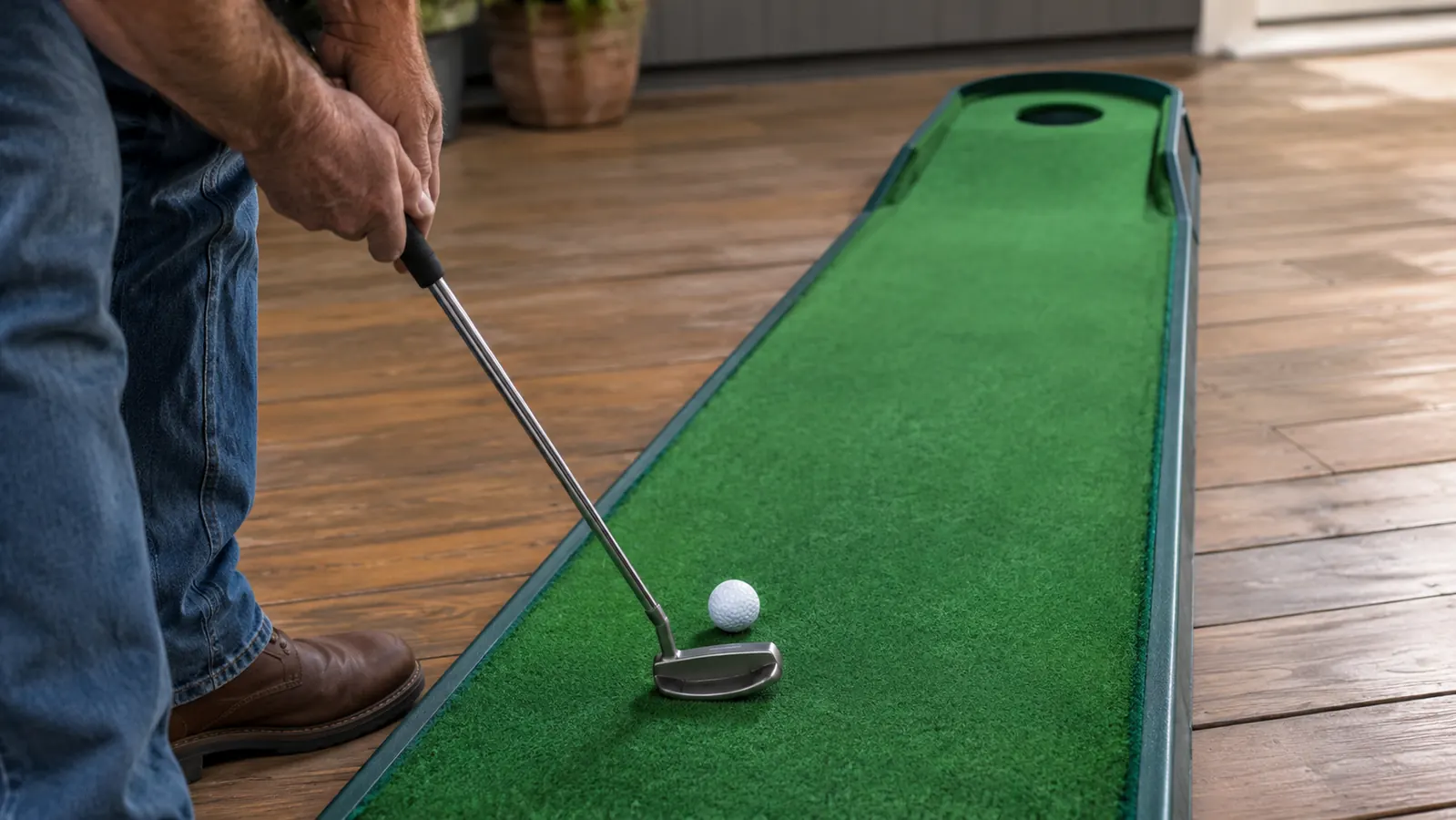
The first thing you notice is that this is not a strip of carpet with a hole cut in it. The Putt-A-Bout surface is a molded, textured material with some weight to it, and a ball rolls over it with a clean, even sound. No skips, no bounces, no dead spots. That even roll is the whole point. A carpet lies to you because every carpet is a different speed, and the ball rolls differently depending on the nap. This mat is the same speed every single time, which means the feedback you get is honest feedback.
The cup is at the far end, raised up a few inches on a molded ramp, and it is a regulation-size cup. A putt that drops comes right back to you down the ramp. A putt that misses stays on the mat in front of you, which is almost as useful, because you can see exactly how you missed it. Did it slide right? Did you leave it short? The mat tells you the truth and then lets you try again immediately. That immediate feedback loop is why I think this thing has actually helped my game, and why it gathers dust in so many garages when people don't use it that way.
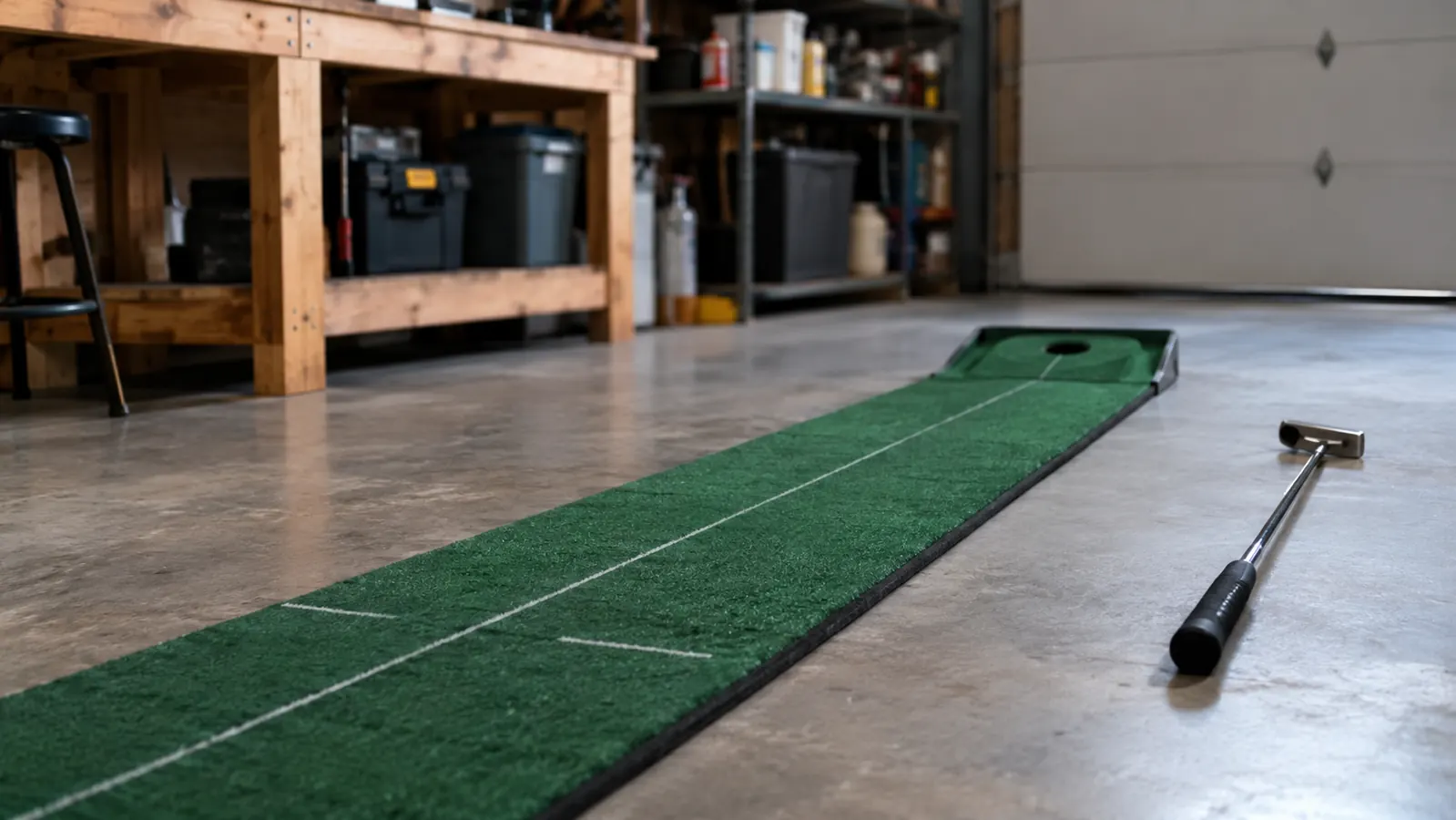
Storage is simple. When I'm not using it, it rolls up into a cylinder about the size of a sleeping bag and leans in the corner of the garage. It takes up less room than my push broom. On the concrete floor it stays put with no tape and no weights. On a smooth tile or hardwood floor, you might want a rug under it, because the surface can slide a little on very slick floors. My garage floor is concrete, so it has never moved on me.
How It's Held Up Over Months
Here is the part that surprised me. I bought this thing expecting it to be a six month disposable, the way a lot of practice gear is. Nine months in, the surface still rolls exactly like it did the first week. No bald spots, no peeling, no curled edges, no soft spots where the base has given out. The cup and the return ramp still work the same as day one. My garage gets hot and humid in the summer and cold in the winter, and the mat has been through both without complaining.
The only maintenance I've found is that the surface collects dust and the occasional leaf that blows in under the garage door, so I sweep it off before I practice. That's a two second job, not a complaint. The honest thing to tell you is that the mat looks a little lived in if you get down close and look at it. There are faint scuff marks from hundreds of putter strokes, and the area around the cup gets the most traffic. But you have to be within a foot of the surface to see any of it, and none of it has changed the way the ball rolls.
What It's Done for My Game
The biggest change is inside five feet. Those are the putts that used to cost me two or three strokes a round, the short ones you are supposed to make. Now when I stand over a four footer on the course, I have already made that putt a hundred times in my garage, and my hands know what to do. Confidence on short putts is a real thing, and this is the first practice tool that has ever built it for me.
It has not turned me into a great putter. I want to be clear about that, because nobody should buy a putting mat expecting a fix for a broken stroke. What it does is sharpen what you already have, and it keeps you sharp between rounds. Two guys in my Tuesday group have asked about mine, and one of them bought his own after I let him roll a few putts. That's about the highest compliment practice gear can get.
The Honest Tradeoffs
First, the surface is flat, so you can only practice straight putts. There is no way to set up a breaking putt, which means this mat is not a substitute for reading greens. You still have to do that work on the course. What the mat does is give you a reliable stroke to aim with, so that when you do read the break correctly, you can actually start the ball on your line. That is more valuable than it sounds.
Second, the roll is a little faster than the greens on my public course. That's not a bad thing, because when you go from a fast mat to a slower green, your touch feels soft and smooth by comparison. But it is a difference, and it took me a round or two to get used to it. Third, the ball makes a rattle when it drops into the cup and rolls back down the ramp. In the garage that's fine. If you set this up in the living room, Karen's opinion may differ from yours. She has made her feelings about golf in general clear.
Alternatives I Considered
Before I settled on the Putt-A-Bout, I looked at the other options in this space. There are cheap strip mats with a hole at one end and no ball return, and I almost bought one of those because the price looked friendlier. What stopped me was the thought of bending over to pick up a ball after every putt, which I knew would end my practice session in about five minutes. The ball return on this mat is the difference between practicing and quitting, and I think it's worth paying for.
I also thought about a bigger mat, the kind that takes up half a room and lets you practice lag putting. That would be nice to have, but I don't have the space, and I'd end up leaving it rolled up in the corner because setting it up would feel like a project. The whole point of this mat is that it's ready to use in two minutes. If a practice aid is not easy to set up, you won't use it, and if you don't use it, it doesn't matter how good it is.
What I Liked
- Flat, dense surface that rolls true and stays true for months
- Ball return means you never bend over to fetch a putt
- Regulation-size cup makes you commit to a line
- Lies flat on concrete and rolls up for easy storage
- Long enough for a real putting stroke, not a desk toy
Where It Falls Short
- Straight putts only, no way to practice breaking putts
- Rolls faster than many public course greens, takes a round to adjust
- Needs a flat, clean floor to perform at its best
- One cup and one target, so practice variety is limited
Nine months and thousands of putts later, the surface still rolls exactly like it did the first week. I cannot say that about any other piece of practice gear I own.
Who This Is For
This is for the golfer who loses strokes to three-putts and wants an honest place to practice at home. It's for the weekend player in a cold climate who can't get to the course all winter. It's for the older golfer who wants to keep the stroke alive without a full practice facility. It's for the beginner who needs to learn what a square, solid stroke feels like. If you have a flat space about 3 by 9 feet, a putter, and fifteen minutes most evenings, you are exactly who this mat was made for. If you're not that person, keep reading, because there's a case for skipping it too.
Who Should Skip It
Skip it if you're hoping to practice breaking putts, because this mat is flat and that's the whole design. Skip it if you're looking for a full-size practice green with multiple holes, because this is a single cup on a 9 foot strip. Skip it if you have nowhere flat to put it, because the mat is only as good as the floor under it. And skip it if you think a piece of practice gear is going to fix your mechanics for you. No mat does that. The Putt-A-Bout Par Three is a tool that makes practice easier and more honest. You still have to show up and do the work. If you're willing to do that, it's been the best value in my garage.
Bottom line? If you want to get better at putting, you need reps, and reps need a surface you trust. The Putt-A-Bout Par Three has been that surface for me for nine months, and it's still going strong. It's not fancy and it won't do the work for you, but it will make the work worth doing. For a guy who came to golf late and needs every practice advantage he can get, that's been enough.
If you've been three-putting all season, this is an easy place to start fixing it
Nine months in, the Putt-A-Bout Par Three is still earning its spot in my garage. Check today's price on Amazon and see what current owners are saying.
Amazon Check Today's Price on Amazon →