
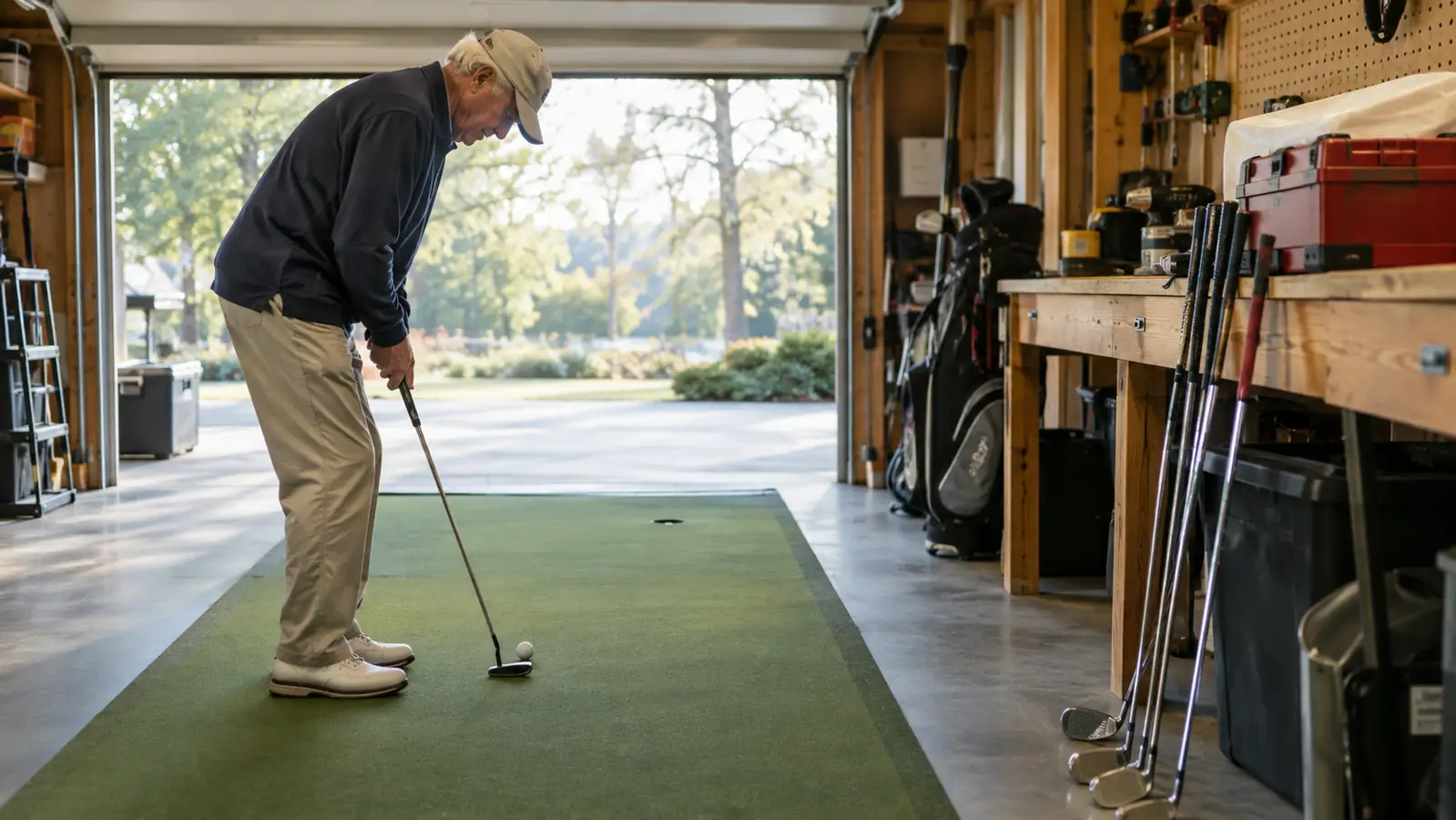
I turned 61 this year, and I have been chasing a single-digit handicap since I took up golf seriously at 52. That is nine years of Tuesday mornings with the same group at the same public course in the Upstate of South Carolina, and nine years of watching good drives and decent irons get wasted by three-putts. Last winter I finally got tired of it. I cleared a corner of the garage, unrolled a PUTT-A-BOUT Par Three Putting Green, and started putting for twenty minutes most evenings. This is the honest version of what happened, including the parts that did not work.
The 3 by 9 foot green that changed my winter practice
I put this green in the garage in January and used it almost every night through March. It is the same PUTT-A-BOUT Par Three model thousands of golfers practice on, and it is the one I would buy again.
Amazon Check Today's Price on Amazon →It turns twenty dead minutes into real practice
The biggest lie I told myself for years was that I had no time to practice. The truth is I had twenty minutes between dinner and the news, and I spent them on my phone. Once the PUTT-A-BOUT was unrolled in the garage, those minutes had a place to go. I did not need to drive anywhere, change shoes, or book a tee time. I just walked out, grabbed the putter, and started. Twenty minutes a night, five nights a week, is an hour and forty minutes of putting practice that used to be zero.
You practice the stroke, not the grass
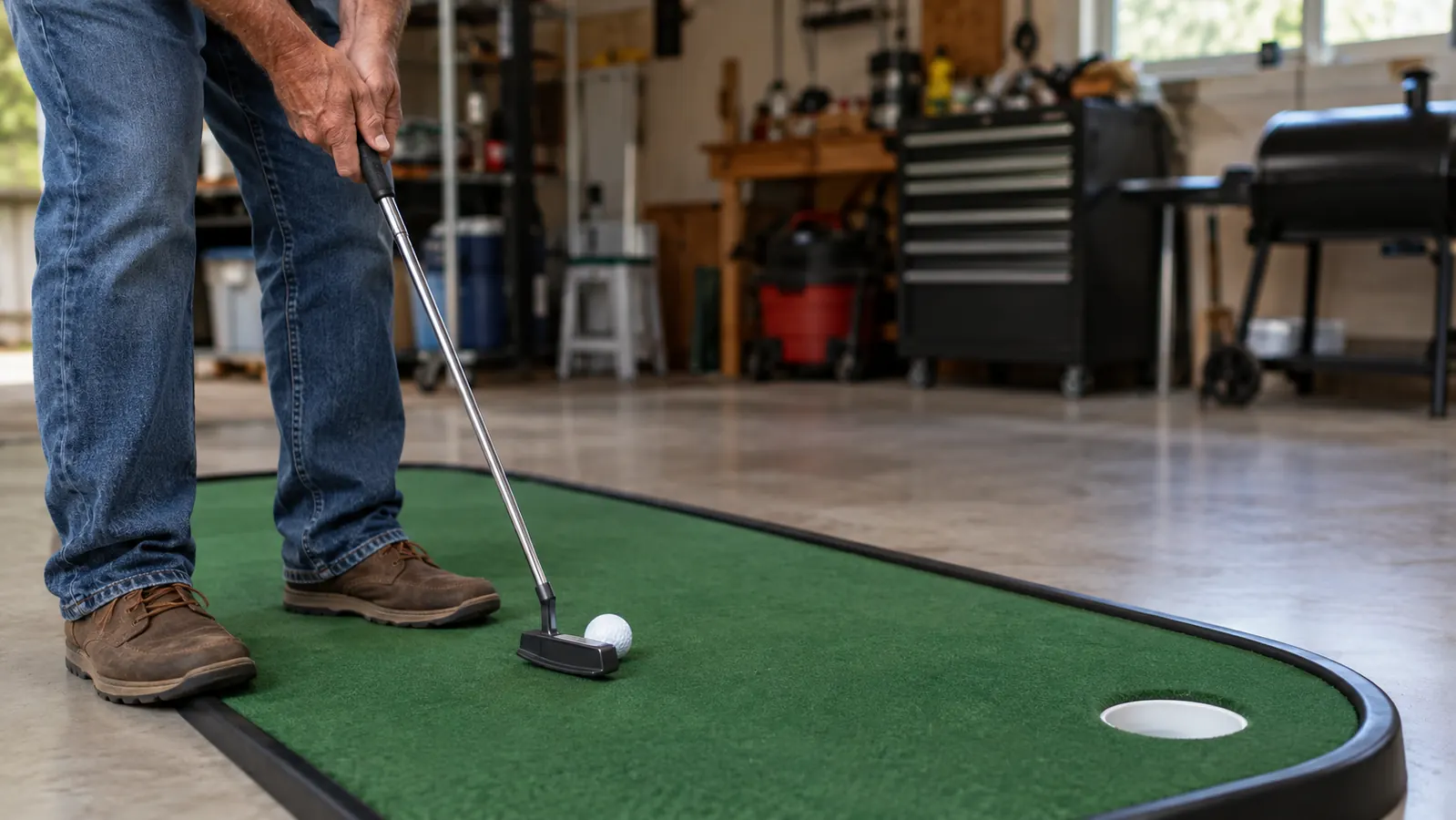
My home course has Bermuda greens that get grainy by August, and I used to blame them for every missed putt. The PUTT-A-BOUT does not roll like Bermuda, and that is fine. What it does is give you a flat, consistent surface so you can work on the stroke itself. I focused on a pendulum motion with my shoulders instead of a wristy jab, and that carried over to the course even when the grass was different. The green is not a simulation of my course. It is a rehearsal space for the motion.
Three cups give you three different reads
The Par Three has three holes cut into it, and I did not appreciate that until I had owned it for a week. The center cup is straight, the left cup has a subtle break, and the right cup sits at an angle that punishes a lazy stroke. I started rotating through them instead of hammering the same putt over and over. That small change made practice feel like a game, and it forced me to read the surface before every putt instead of going on autopilot.
You learn to make the putt that matters
The shortest putts are the ones I used to give away. A three footer with a little break should be automatic, but I would rush it and lip out. On the PUTT-A-BOUT I started every session with ten three footers in a row before I was allowed to move to the longer ones. The rule was simple: miss one, start over. The first night it took me eleven tries to get through ten. By March I could do it cold. That is the putt that saves bogeys, and I stopped giving so many of them back.
It fixes the yips before they become a habit
I developed a flinch in my right hand on short putts, and it got worse the more I thought about it. The PUTT-A-BOUT let me work on it in private, where nobody was watching and the stakes were zero. I spent two weeks putting left-hand-low, which felt terrible at first, then natural. By the time the Tuesday group saw it, the flinch was gone. You cannot fix a flinch in front of your buddies. You can only fix it alone in the garage, and this green gave me a place to do that.
You build a routine you can trust on the course
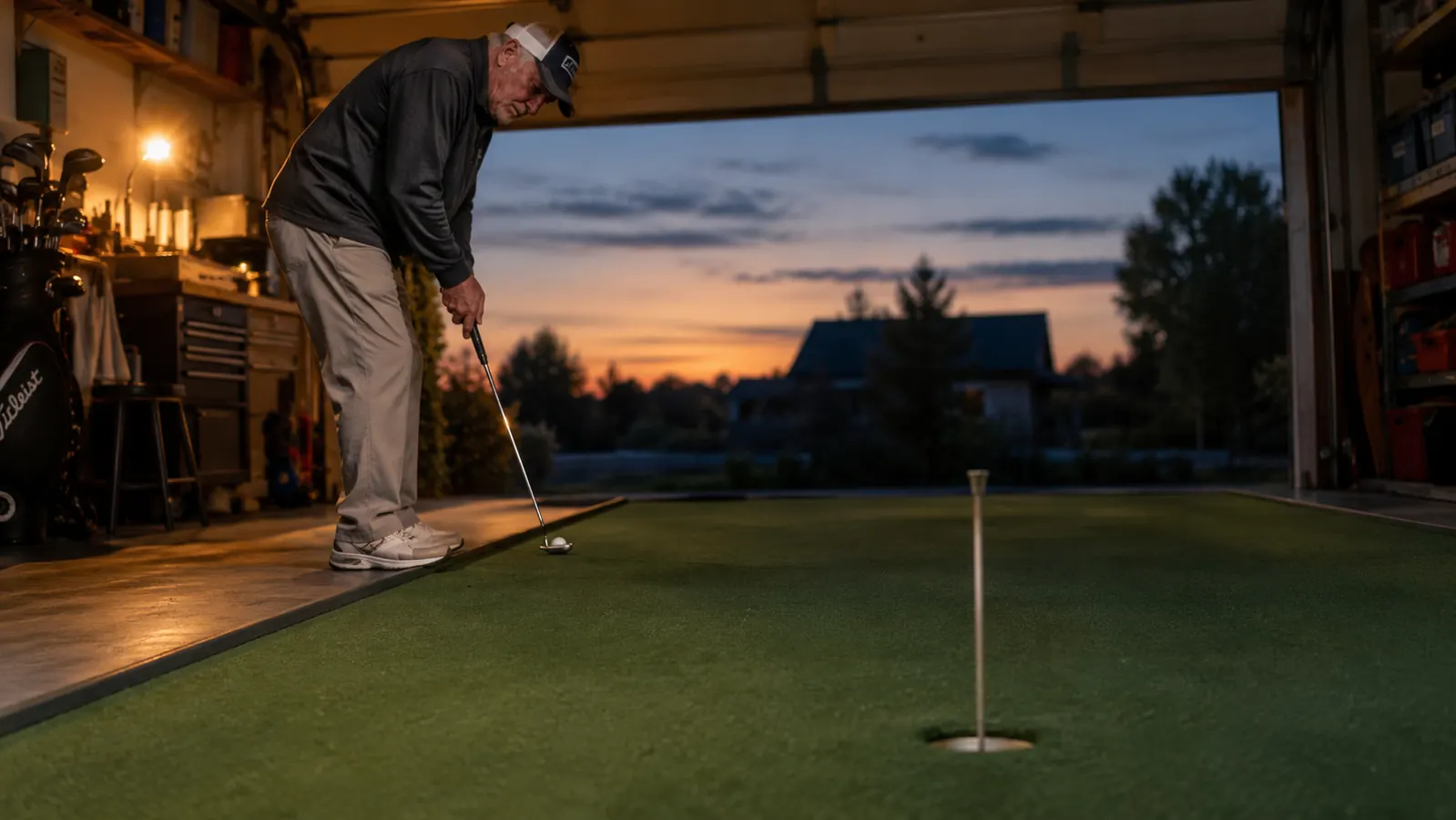
Before the garage green, my pre-putt routine was whatever I happened to do that day. One practice step, one look at the hole, then hit. On the PUTT-A-BOUT I built a fixed routine: stand behind the ball, pick a spot six inches in front, take one practice stroke, set the putter down, go. I did it so many times that it became automatic. On the course now, when the Tuesday group is waiting and the pressure is on, my body runs the routine without asking my brain for permission.
It makes winter practice possible in the Upstate
January in South Carolina is not Minnesota, but it is still cold, wet, and dark by five. The course is open, but the greens are often soft and the wind cuts through you. Last winter I played maybe four rounds between New Year and March. Without the PUTT-A-BOUT, that would have meant four months of zero putting practice. Instead I came out of winter with a stroke that was actually better than the one I went in with. That has never happened before.
It is honest about your misses
A putting mat that is too small lets you cheat. You can hit a bad putt and still watch it drop because the cup is six inches away. The PUTT-A-BOUT is nine feet long, so a putt hit off line has room to wander. I found out my distance control was worse than I thought, because on a short mat every putt looked fine. On this green, a putt that is too firm does not drop, it skips over the cup and ends up three feet past. That feedback is the whole point.
It gives you a reason to keep the putter in your hand
The garage used to be where my clubs went to die between November and March. Now the putter lives on a hook next to the workbench, and the PUTT-A-BOUT stays unrolled on the floor. I pick the putter up when I am waiting for paint to dry or thinking through a problem. Some of my best practice sessions were not planned. They were five minutes here and ten minutes there, and they added up to something real by spring.
It lowers your score where it actually counts
I am not going to tell you the PUTT-A-BOUT shaved ten strokes off my handicap, because it did not. What it did was cut my three-putts from about three a round to one or two. On a course where a bogey is always one bad putt away, that is two or three strokes a round that I stopped giving away. My handicap went from 18 to about 16.5 over the winter, and most of that was putting. That is the difference between shooting 92 and shooting 88, and I will take it.
What I'd Skip
If you are expecting a perfect simulation of a real green, skip this. The PUTT-A-BOUT rolls fast and true, but it is not Augusta, and it will not teach you to read the grain on Bermuda. It also will not fix your full swing, your chipping, or your sand game. And if you are the kind of golfer who buys a practice aid and then never uses it, this will just be a long green rectangle taking up garage space. It only works if you actually walk out there and putt.
I went from about three three-putts a round to one or two, and my handicap dropped from 18 to 16.5 over one winter. That is the difference between shooting 92 and shooting 88.
The same green I put in my garage last January
If you want to give your putting a place to live between rounds, this is the one I bought and the one I would buy again. It is not magic, but it is honest practice space.
Amazon Check Today's Price on Amazon →