

I have owned the PUTT-A-BOUT Par Three for eight months, and this is the review I wish I had found before I bought it. Not the kind that opens with 'best putting green ever.' The kind that tells you the surface is faster than any green on my home course, the cup is shallow enough that a firm putt can hop out, and the ends want to curl like a rolled-up poster until you train them flat. I am a 61 year old retired high school shop teacher who took up golf at 52, and putting has always been the weakest part of my game. I carry an 18 handicap and I play with the same Tuesday group at the public course, and they will tell you I have given away more short putts than anyone they know. That is exactly why this mat ended up in my garage, and why I can tell you precisely what it does and what it does not do.
Here is the short version before the details. The PUTT-A-BOUT is a 3 foot by 9 foot foam-backed putting surface with one cup cut at the far end. You roll it out, you putt, you roll it back up and lean it against the wall. It is not a fancy trainer with sensors and an app. It is not a full-size green that swallows the garage. It is a simple mat that does one job, and after eight months of nearly daily use it still gets more action than the practice net I keep next to it.
The Quick Verdict
A fast, simple 3x9 putting mat that earns its space in any garage. It curls, the cup is shallow, and it will not fix a bad stroke by itself. For daily short-putt practice without taking over the room, it is a solid buy and I would get it again.
Amazon Check Today's Price →I would buy it again. Here is the honest part first.
The PUTT-A-BOUT Par Three has real flaws, and this review covers every one of them, including the ones the product photos leave out. If you want the plain-spoken version of what eight months of daily use taught me, keep reading. If you want to skip ahead, check today's price and the current customer reviews on Amazon.
Amazon Check Today's Price on Amazon →How I've Used It
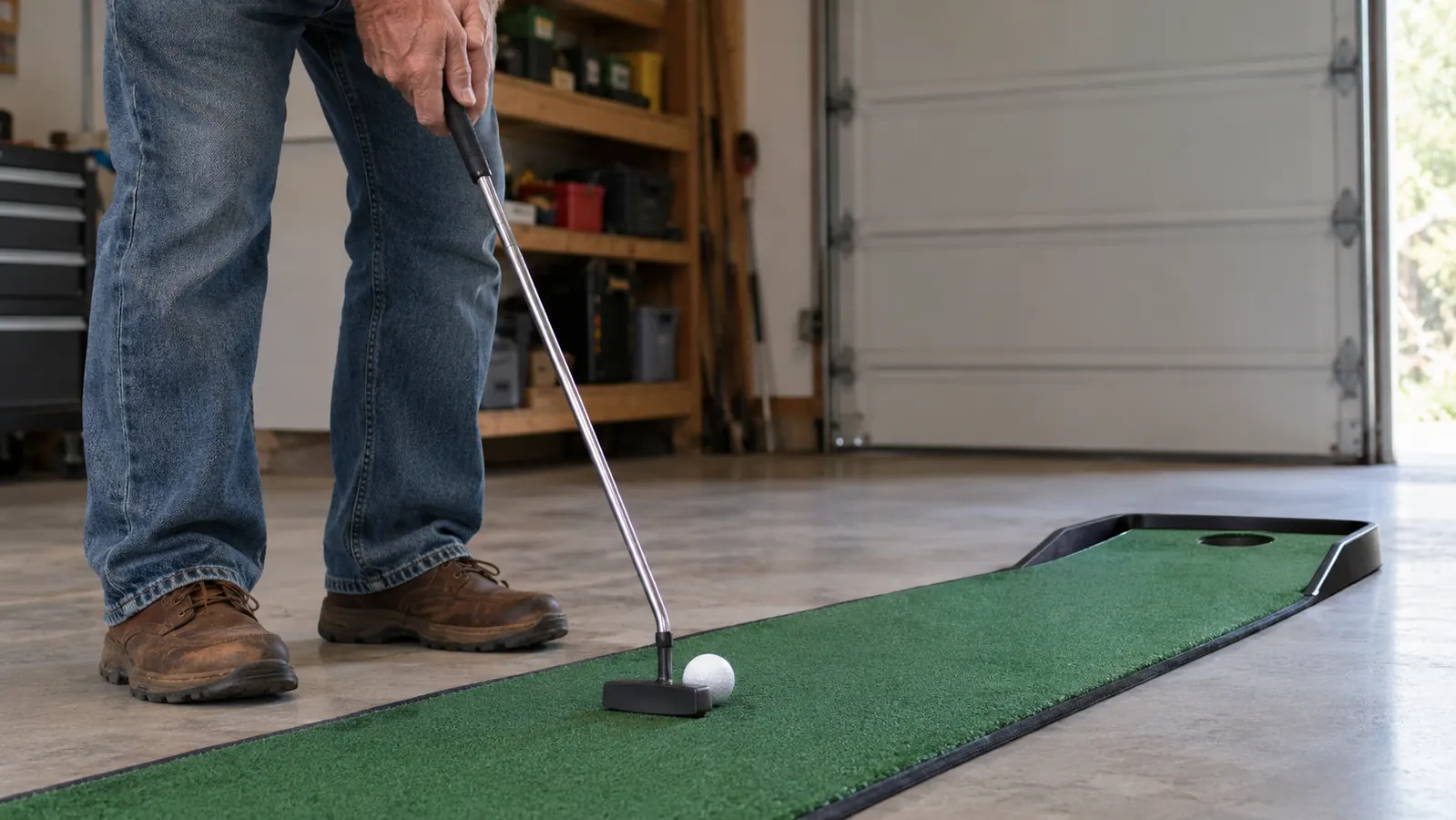
The setup is nothing fancy. The mat lives rolled up in the corner of my garage, and most evenings I drag it out onto the concrete floor in front of my workbench. I putt from three feet, five feet, and seven feet, maybe ten or fifteen minutes a night, usually while Karen watches something I do not care about inside the house. In the winter it is the only golf I get between Tuesday rounds, and in the summer it is how I keep the stroke honest when the heat drives me off the course by noon.
To be clear, I am not grinding out there. I am not doing drills with alignment sticks and a metronome. I set a ball down, I look at the cup nine feet away, and I hit putts until my shoulder tells me to stop. The mat gives me instant feedback, because the surface is so fast that any putt with wrist in it sails six feet past the cup. You learn to make a quiet, compact stroke in a hurry, or you learn to love chasing balls around the garage.
Over eight months, that adds up. I cannot promise you the mat fixed my putting overnight, because it did not. What I can tell you is that I stopped dreading the four and five footers in our Tuesday money games, and that is a change I can put a number on. The mat itself has held up fine, no tears, no worn path where I putt, and the cup edge is still in one piece. I checked it closely before writing this, because that is the part I expected to fail first.
What Nobody Tells You Before You Buy It
Here is the part the product photos leave out, and it is the part that matters. First, the surface is fast. Not a little fast. Faster than the greens at my public course, and they get cut short and rolled every week. The first night I used this mat I left putts four feet past the cup from eight feet out, and I laughed out loud. That speed is not a flaw exactly. It teaches you a soft touch, and it makes real greens feel slow by comparison. But if you buy this expecting the same roll as the indoor carpet at the pro shop, you will be surprised.
Second, the ends curl. The mat ships rolled up in a box, and it wants to stay rolled. Out of the box, the two ends will not lie flat, and a ball rolling to the end will hop over the edge. Fixing it is simple but it takes patience. Lay it flat, put something heavy on both ends, and leave it for a few days. In cold weather it takes longer, and some reviewers say theirs never lies completely flat. I believe them, because mine still tries to lift a little on humid days. This is the single most common complaint you will see in the reviews, and it is real.
Third, the cup is shallow. It is a regulation size cup cut into the surface, but there is no deep sleeve under it, so a firm putt can lip out or hop over the top. I have mixed feelings. It punishes lazy putts, which is good. It also means the ball does not drop the way it does on a real green, which takes getting used to. And fourth, on a smooth floor the mat can slide if you step on the edge just wrong. A piece of non-slip shelf liner underneath fixes that, but it is worth knowing before you buy rather than after.
Why does none of this show up in the product photos? Because the photos show a brand new mat lying flat on a beautiful floor with perfect light, and nobody photographs the third day of training the ends flat. Most of the five star reviews on Amazon are short and enthusiastic, and the useful information is buried in the three and four star reviews. That is normal for a product like this. It does the job, so people round up, and the quirks get lost. This review is my attempt to give you the quirks up front.
What It Does Well
For everything it does not do, the PUTT-A-BOUT does the one thing that matters most. It gives you a true, consistent roll. The surface is uniform from one end to the other, so every putt rolls exactly the way your stroke delivered it. That is the whole point of practice. When I putt across my living room carpet, the nap grabs the ball and I learn nothing. On this mat, a pushed putt stays pushed, a pulled putt stays pulled, and a solid putt rolls end over end into the cup. That honesty is worth more than any gimmick.
The 9 foot length is also right for a real putting stroke. A lot of cheap mats are four or five feet long, which is barely a tap with the putter. Nine feet gives you room to make a full shoulder stroke and work on distance control, which is where I lose most of my strokes. The 3 foot width is enough to stand on and address the ball the way I do on the course. And the whole thing rolls up in ten seconds and leans in the corner, taking up less space than a lawn chair. That ease of use is the reason it gets used, and getting used is the whole game.
It also works on the driveway on a dry day. I have dragged it outside a few times and putted in the sun, and it lies flat on clean concrete. I would not leave it out overnight, and you would not want to putt on it wet, but for the occasional outdoor session it is fine. Mostly it is a garage tool, and it is the right tool for that job.
Where It Falls Short
Let me be straight about the things that annoy me, because an honest review has to cover the bad along with the good. First, there is no ball return. A putt that misses the cup rolls off the far end and across the garage, and you walk to fetch it, every single time. On a 3 foot wide mat you will not be running marathons, but it is not the hands-free practice you get from a pricier trainer that spits the ball back at you.
Second, the fast surface cuts both ways. It is great for learning a soft stroke and it is terrible for anyone who already has a tentative stroke, because it will make you even more timid. If you already leave putts short on real greens, this mat will not fix that. It will show you the problem in vivid detail, but the fix is on you. Third, the foam is thin. You feel the floor underneath, and on a hard garage slab that gets old after ten minutes. A cheap rubber mat under it helped me a lot.
One more honest note, and it is the note most reviews skip. The cup edge is the part most likely to wear. Mine has held up for eight months, but I have read plenty of reviews from people whose edge frayed or chipped a lot sooner. I would not call it a defect. It is the nature of a cup cut into a foam mat that gets rolled and unrolled constantly. If you are hard on your gear, that is the first place you will see it, so treat the edges gently and it will treat you well.
What I Liked
- Rolls fast and true with a consistent surface from end to end
- Nine feet of length fits a full putting stroke
- Sets up and stores in under a minute
- Works indoors or on a dry driveway
- Held up through eight months of daily use
Where It Falls Short
- Ends curl out of the box and need a few days of training to lie flat
- Cup is shallow, so firm putts can lip out
- No ball return, you will chase every miss
- Surface is faster than most real greens
- Thin foam, you feel the floor underneath
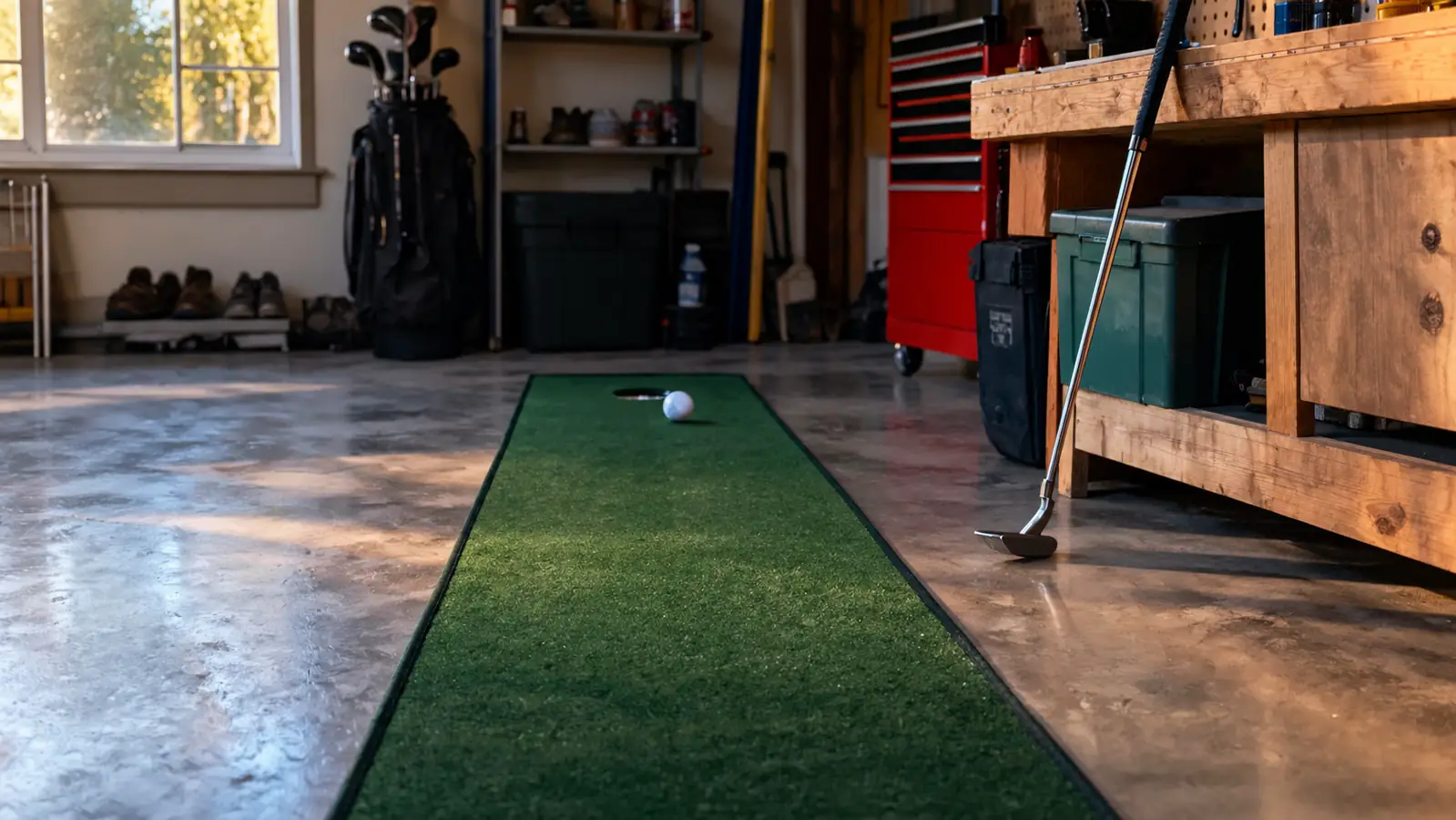
My first night on this mat I left putts four feet past the cup from eight feet out. It is faster than any green on my home course, and that is the first thing nobody tells you.
Who This Is For
Buy the PUTT-A-BOUT Par Three if you want ten or fifteen minutes of real putting practice at home without giving up the garage. Buy it if you are a weekend golfer whose short game leaks strokes, if you live somewhere with winters that close the course, or if you just want something to do with a putter while the coffee brews. It is also a fine first putting mat for a beginner, because it will not hide a bad stroke the way thick carpet does. If that sounds like you, this is a low-risk way to find out whether home practice actually helps your game.
Who Should Skip It
Skip it if you want a trainer that returns the ball, tracks your numbers, or simulates the feel of a bentgrass green. Those exist, they are a lot more expensive, and for some people they are worth every cent. Skip it if you have an uneven floor, because a thin mat will not fix a slope and the ball will roll wherever the floor wants it to go. And skip it if you expect any piece of practice gear to fix your putting by itself. This mat shows you the truth about your stroke. It does not fix the stroke for you, and no mat does.
Alternatives I Considered
I did not buy this mat blind. Before I settled on the PUTT-A-BOUT, I looked hard at the SKLZ putting green, which has a sturdier base and a ball return, and for a lot of people that is the better buy. It is pricier and it takes up more space, and if you are torn between the two, that is the comparison I would point you to. I also tried a cheap fold-up mat from a big box store a few years back, and it was a waste of money. The surface wrinkled, the ball wobbled, and I stopped using it inside a month.
What sold me on the Par Three was the combination of length, simplicity, and the fact that it does not pretend to be anything but a mat. I knew I would actually use it, because rolling it out takes ten seconds and rolling it back up takes ten more. The fanciest trainer in the world does you no good if it is a hassle to set up, and the cheapest mat does you no good if it teaches you nothing. This one hits the middle, and the middle is where most of us actually live.
The Bottom Line
So here is my honest verdict after eight months. The PUTT-A-BOUT Par Three is not perfect, and anyone who tells you otherwise is selling something. The ends curl, the cup is shallow, the surface is fast, and you will fetch a lot of missed putts. But it gives me a true roll, it takes up almost no room, and it has survived a full season of daily use without falling apart. For the space it takes and the hassle it saves, it is the best practice investment I have made since I started playing this game.
Would I buy it again? Yes, and I would not have to think about it long. But I would do the three things I listed. Weight the ends flat for a few days, put something non-slip underneath, and accept that it rolls faster than the greens you actually play. Do that, and you get a simple, honest practice tool that shows you exactly what your putting stroke is doing. If you can handle that truth, this mat is for you. If you cannot, no mat in the world will help.
Still on the fence? That is fair.
The PUTT-A-BOUT Par Three is the most-used piece of practice gear in my garage, and this review tells you exactly why, warts and all. If it sounds like a fit for your setup, check today's price and the current customer reviews on Amazon. If it does not sound like a fit, skip it and save your money. That is the honest version.
Amazon Check Today's Price on Amazon →