
Three-putts are the cheapest strokes you will ever hand back to the golf course. I have been an 18 handicap for the better part of six years, and I can pound range balls all winter and maybe gain myself one stroke a round. But stop three-putting twice a round and you have just picked up two strokes without swinging any harder. Nobody gives those back with a driver. I finally did something about my own three-putts this past season, and the fix was not a new putter, not a lesson, and not more time on a crowded practice green. It was a putting surface in my own garage, where I could work on it every single evening.
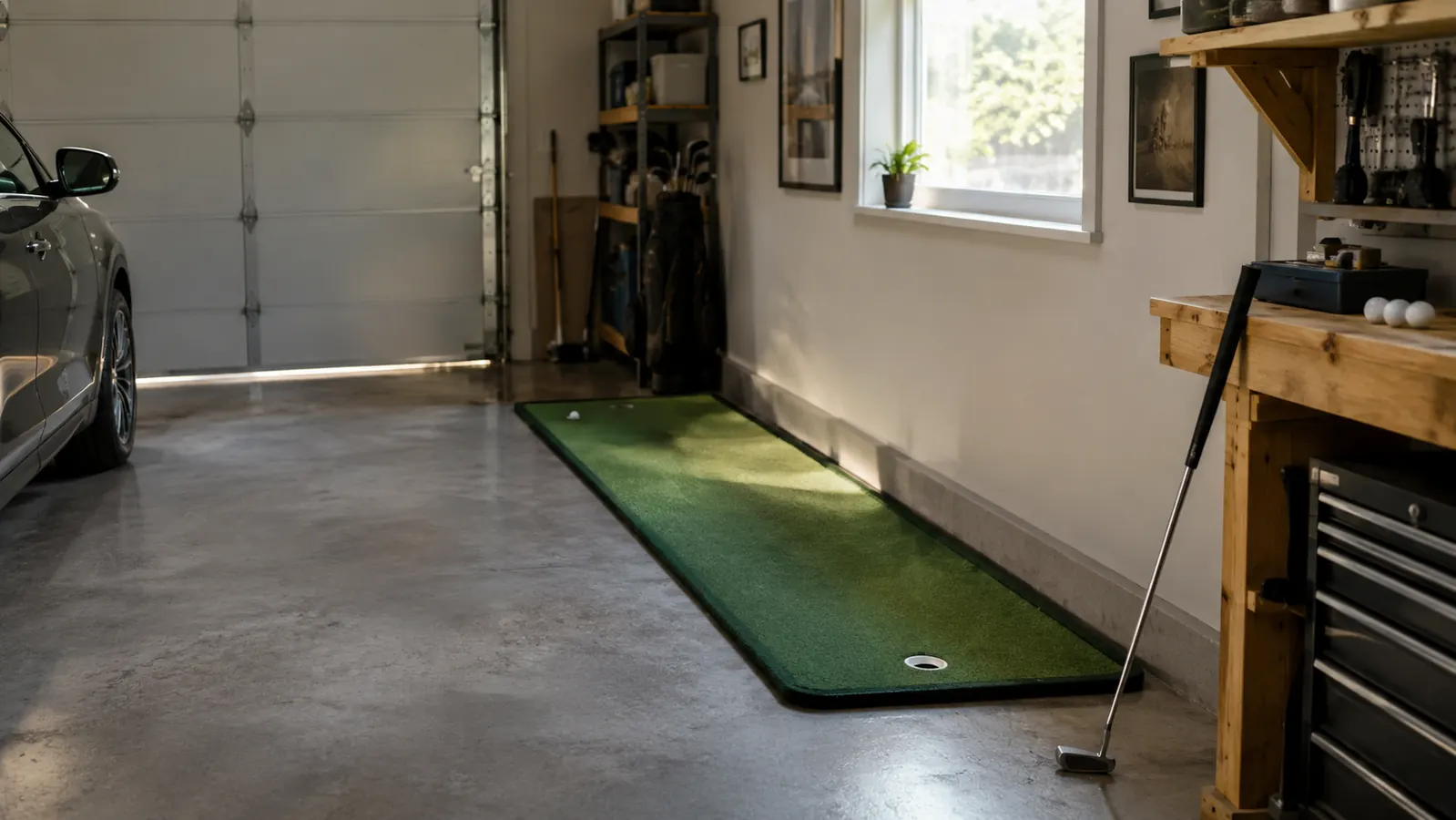
The options out there run from a thin strip of carpet to a full simulator, and I settled in the sensible middle with the PUTT-A-BOUT Par Three. It is three feet wide and nine feet long. That size fits along a garage wall and still gives you a real putt across a real distance. It rolls true enough to be worth your evening, and it is light enough that moving it is not an excuse. The surface stays out, flat, in the spot I walk past every morning. A green you can step onto without digging anything out is the one you will actually use, and using it is the whole point.
The green that lives on my garage floor
I have had the PUTT-A-BOUT Par Three set up for a full season, and it is the first thing I walk past every morning. If you are tired of giving strokes away on the greens, this is the surface I would start with.
Amazon Check Today's Price on Amazon →Step 1: Set it up where you will actually use it
The biggest mistake I made with my old putting mat was storage. I rolled it up and shoved it behind the workbench, and it stayed there for a year, collecting dust while my three-putts collected. The PUTT-A-BOUT does not get that treatment. It sits flat on the garage floor beside the pickup, out of the way of the door, in the path I walk a dozen times a day. Out of sight is out of mind, and a rolled-up mat behind a workbench is about as out of sight as it gets.
The first evening I laid it out, it curled at both ends from living in the box. I set a couple of spare floor tiles on the edges and left them overnight, and by morning it was flat. It has stayed that way through a full season of the garage heating up and cooling down. A little weight at the edges for one day beats fighting a curled surface for a month, so do not skip that step or you will blame the product for something a floor tile fixes.
Placement is the whole trick, more than the brand and more than the price. A green you can step onto without moving anything gets practiced on, and a green you have to drag out of a corner gathers excuses. The garage is not pretty, but pretty was never the point. The point is that when I walk out to the pickup with a cup of coffee, the putter is leaning right there and three balls are sitting on the surface. I practice most nights for no better reason than that the thing is already out.
Step 2: Find out where your three-putts come from
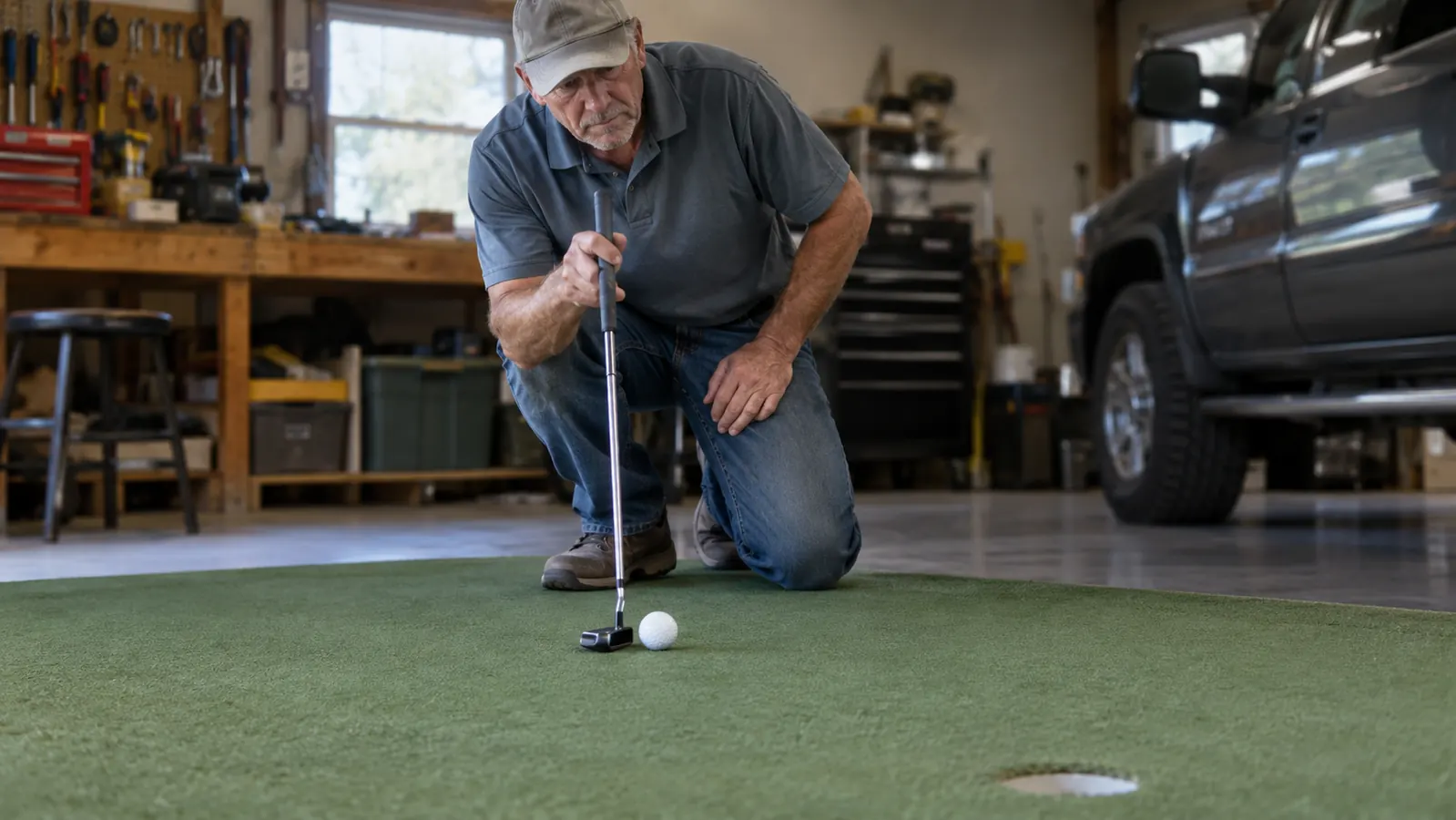
Before you practice anything, find out what is actually going wrong. From what I have seen on the course, three-putts are usually a distance problem, not a line problem. The first putt dies six feet short or rolls five feet past the hole, and then your hands tense up on the comeback putt and you miss that one too. Fix the distance control and a lot of the rest takes care of itself. A nine-foot green is plenty of room to work on speed, and the cup at the far end gives you a target that behaves like the real thing.
Here is the test I ran the first night. Set up at the far end of the surface in front of the cup and putt ten balls, trying to stop each one within three feet of the hole. Count how many make that circle. My first ten putts only put four inside three feet. That is a number I did not want, but it handed me something specific to work on, and specificity is the whole game. If your first number is better than mine was, you are already ahead of where I started.
Run that same ten-putt test once a week and write the number down. Four out of ten became six, then seven, then eight over the course of the season. A number beats a feeling every time, because a feeling lies to you and a number does not. You cannot fix what you have not measured, and this is the part of practice nobody wants to do. It is also exactly the part that pays off, because once you see the number move, the whole routine stops being a chore and starts being a game.
Step 3: Make the three-footer boring
The putt you three-putt with is almost never the long one. It is the comeback putt, the little one you should not have to think about. That is why I made the short putt my main job. Once a ball inside five feet stops being scary, you will not give those away on the course. You will not be the one who three-putts from the fringe, and you will not stand over the par putt with the whole Tuesday group watching and feel your hands start to sweat.
The drill I used is the clock drill. Set a ball three feet from the cup, make the putt, move to the next position around the cup like numbers on a clock, and go all the way around without a miss. When you can do the full circle, move to four feet, then five. On a nine-foot green you have room for every distance in that progression, and the whole session takes less time than the drive to the course. Short, focused, and done.
I did the clock drill most nights for two weeks. Somewhere in that second week the three-footer stopped feeling like a putt and started feeling like a tap-in. That is the whole goal. You want the short one to be so routine that your hands never get involved in the decision. When that carries over to the course, you will not even feel the tension. The ball just goes in the hole, and the guy you are playing with says nice putt, and you have already forgotten about it, which is exactly how it should be.
Step 4: Put a gate in front of the ball and work on a straight stroke
The other place three-putts come from is a stroke that pushes or pulls the ball off the line. The ball starts wrong, the line is never true, and you spend the whole putt trying to save it with speed. A straight, simple stroke fixes more of that than any putter on the rack. This is where a little attention to mechanics earns its keep, and it is the easiest thing in the world to practice at home on a flat, true surface.
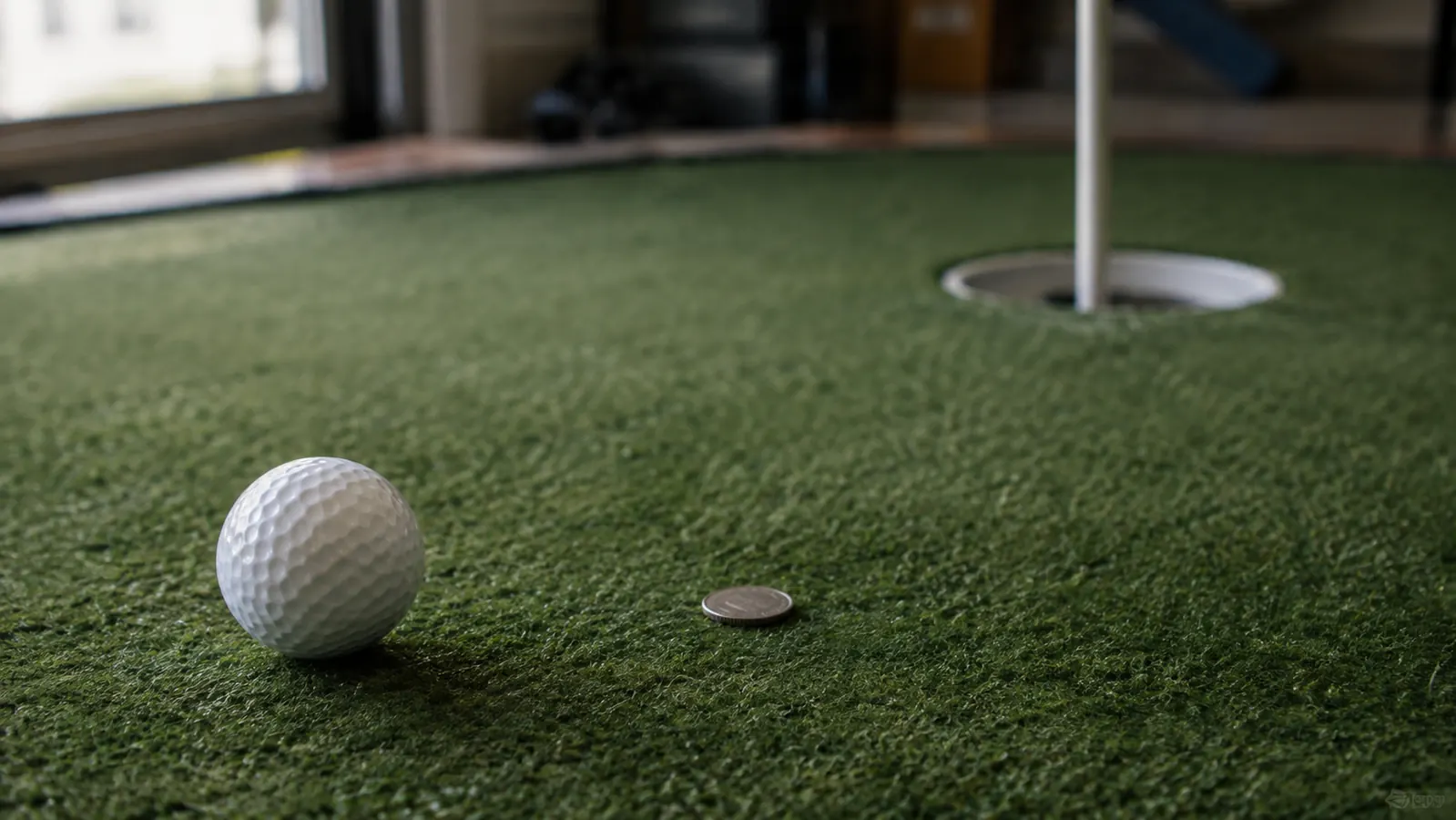
The gate drill does not need anything fancy. Set two tees just wider than your putter head a few inches past the ball, then stroke the putt through the gap without touching either tee. If you tick the tees, your path is off, and the putt was off too. Run the drill at four feet, then six, then eight. The whole length of the green is your practice area, and nine feet is enough to expose a real path problem that is costing you putts on the course.
You can build the same gate with two coins or two spare balls, so the drill basically costs nothing. The point is not the gear. The point is that your eyes finally see what your hands are doing, and once you see it, you can fix it in a couple of quiet sessions. The gate is what shows you the truth about your stroke, and the truth is what keeps you honest when you would rather blame the green for a putt that was never on line to begin with.
Step 5: Keep it to ten quiet minutes a day and keep a tally
The routine is what lowers scores, not the occasional heroic practice session. Ten minutes on the surface every evening does more than two hours on a random Saturday. I keep it short on purpose. When practice stops being fun, you stop showing up, and a green you do not use is just another thing taking up floor space. Short and daily beats long and rare, and the PUTT-A-BOUT is the kind of surface that makes the daily part easy because it is always sitting there ready.
I also keep score. On a scrap of cardboard above the workbench I count three-putts every time I play. The first month was ugly. Twelve three-putts across four rounds of golf. By the third month the number had dropped to four. That is eight strokes I used to hand straight back to the course, and none of them required me to swing harder. That is the whole reason I put the green down in the first place, and the tally is what proves it is working.
My Tuesday group noticed before I said a word. One of them finally asked why I was not giving so many putts back. I told him about the green in the garage and the tally on the cardboard, and he just shook his head. The next week he showed up with a measuring tape and started mapping out his own garage. That is the best compliment the whole arrangement has gotten, and it tells me the habit is real. The practice does not feel like work anymore. It is just part of the evening.
What Else Helps
A couple of extras made the practice better without turning it into a project. I use the same putter on the home surface that I use on the course, not the old one from the back of the closet. I also putt the same ball I play on Sundays. Feel is the whole game indoors, and switching balls ruins feel. Keep the setup identical to your course setup so that what you practice carries over when the ball is sitting on a real green with a real round on the line.
I strung a chalk line down the center of the surface one afternoon to check my starting line, and it took ten minutes. A straight floor joint works just as well. And I always end a session on a make, even if I have to back up a foot to do it. Ending on makes is what keeps you coming back the next night. The PUTT-A-BOUT has sat in my garage for a full season now, and it still does that job every evening. That is really all you need from a piece of practice gear.
One maintenance note. The surface collects garage dust, and dust makes putts roll slow. I give mine a quick once-over with a damp rag every couple of weeks, and I keep the floor in front of it swept. Five minutes of upkeep keeps the roll true, and a true roll is the only way practice tells you the truth. That is the whole maintenance program, and it is nothing a retired shop teacher cannot handle.
Twelve three-putts one month, four the next. Eight strokes I used to hand back, and none of them needed me to swing harder.
Ten minutes a night and a flat spot in the garage
The PUTT-A-BOUT Par Three has sat on my garage floor for a full season, and it is still the first thing I walk past in the morning. If three-putts are costing you strokes, this is the surface I would put down this week.
Amazon Check Today's Price on Amazon →