

I did not start walking the course to get more exercise. I started walking because my back told me to. I am Walt, 61, retired shop teacher, and I play a public course in the Upstate of South Carolina twice a week with the same Tuesday group. For years I rode in a cart and told myself the walk was for younger guys. Then one round last spring, I got out of the cart on the 12th tee and could barely stand up straight. My wife Karen heard about it for a week. A buddy in my Tuesday group had been telling me for months to try a push cart. He said the Caddytek CaddyLite 11.5 V3 would save my back. I figured it was worth a try before I gave up the game I waited until 52 to pick up.
Here is the thing nobody tells you: the cart ride is not the problem. The problem is the way you sit in a cart for four hours, then stand up and try to swing. Your lower back tightens up, your hips lock, and by the back nine you are swinging with your arms and your spine is taking the punishment. A push cart keeps you moving, keeps your hips loose, and spreads the load of your bag across a frame that rolls instead of hanging off one shoulder. This guide walks through the five steps I used to switch over without wrecking my back or my budget.
The push cart that got me walking again
The Caddytek CaddyLite 11.5 V3 folds flat, rolls smooth, and has held up to two seasons of my Tuesday group. If your back is telling you to get off the cart, this is the one I would start with.
Amazon Check Today's Price on Amazon →Step 1: Set the handle height so your arms hang naturally
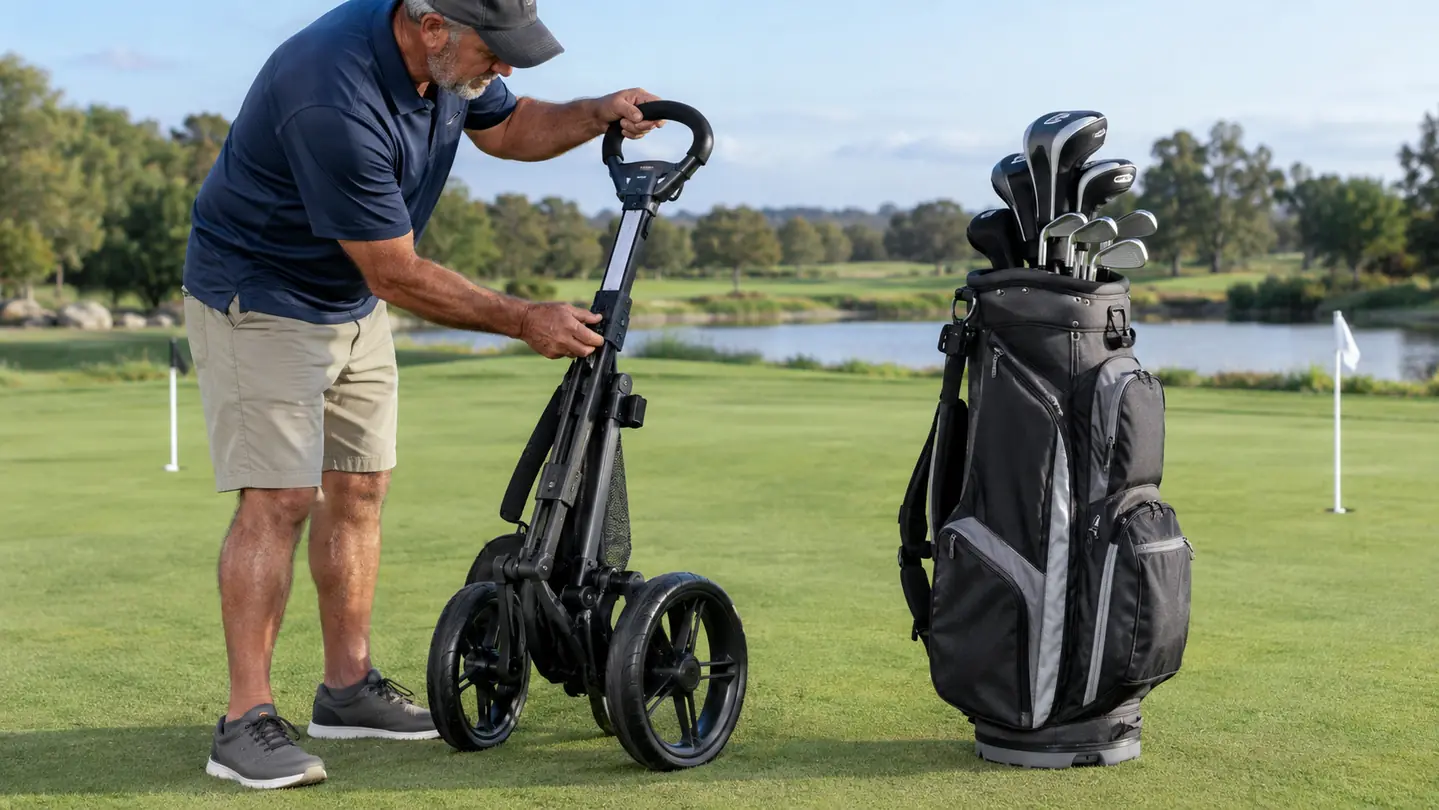
The first thing I did wrong was leave the handle at the factory setting. I am six feet tall, and the stock height made me reach down and forward, which put my lower back in a slight hunch for the whole round. By the 14th hole I was sore in a way that felt exactly like the cart ride I was trying to escape. That first round I actually stopped on the 9th tee, loosened the collar, and slid the handle up two notches right there on the course. It took about twenty seconds and it changed the rest of the day.
The Caddytek handle adjusts in seconds. You loosen the collar, slide it up or down, and lock it back. The right height for me is where my arms hang almost straight down with a slight bend at the elbow, so my shoulders stay relaxed and my spine stays neutral. If you are not sure, set it so your wrists are about level with your belt line when your hands are on the grips. That one adjustment did more for my back than any stretch I have tried.
Take a few practice steps in the driveway before you commit. Walk ten feet, stop, and check whether you are shrugging your shoulders or leaning forward. Your body will tell you in about thirty seconds. Adjust again if you need to. This is a five-minute fix that pays off for the whole round. I marked the right setting with a small piece of tape on the shaft so I do not have to find it again every time I fold the cart.
Step 2: Balance the bag so the weight sits over the wheels
A push cart only helps your back if the bag is balanced. My first time out, I strapped the bag on the way I always carried it, heavy clubs at the top, and the cart wanted to tip backward every time I let go of the handle. I spent the front nine fighting the cart instead of letting it work. On the 6th hole I finally stopped, took everything out, and started over. That reset took five minutes and it was the best five minutes of that round.
The Caddytek has a lower bag rest and a strap that cinches the bag tight against the frame. The trick is to set the bag so the weight of the clubs sits low and close to the wheels. For me, that means the driver and woods go in the top of the bag, but the bag itself sits so the bottom of the bag carries most of the load. When you get it right, the cart rolls straight with one hand and you barely feel the weight.
A quick test: let go of the handle on flat ground. If the cart stays put instead of tipping, you have it balanced. If it falls back toward you, shift the bag down or move the heavy stuff to the bottom pockets. I keep my rangefinder and balls in the lower pocket for exactly this reason. It sounds like a small thing, but it is the difference between a cart that saves your back and a cart that fights you all day.
Step 3: Use the brake on slopes instead of tensing up
My home course is hilly. There are a couple of holes where the cart path drops hard, and my first instinct was to grip the handle and lean back to slow the cart down. That is exactly the move that hurts. You are bracing with your lower back and your arms for thirty seconds at a time, and it adds up over eighteen holes. The first time I walked the 14th hole downhill, I caught myself white-knuckling the handle and had to remind myself the brake was right there.
The Caddytek has a foot brake on the rear wheel. You tap it with your toe to slow the cart, and you press it down to lock the cart in place. On the steep downhills, I tap the brake lightly and let the cart do the work. On the uphills, I keep my arms relaxed and push from my legs instead of my shoulders. The cart has a mesh net and a drink holder, so I also use the brake whenever I stop to grab a drink or a ball, instead of holding the cart with one hand while I bend over.
The habit that helped me most: every time I stop to hit a shot, I lock the brake, set the cart at a slight angle, and take a full breath before I address the ball. It sounds silly, but it turns the cart from a chore into a caddie. You stop fighting the equipment and start playing golf. By the third round, tapping the brake was automatic, and I stopped bracing my back on the downhills altogether.

Step 4: Walk with a loose grip and switch hands on the handle
The second round with the Caddytek, I noticed my right shoulder was sore. I was gripping the handle like I was afraid the cart would run away. The cart does not need that. It has EVA wheels that roll smooth over cart paths and fairway, and it tracks straight without much input from you. I tested it on the practice green one morning: I let go of the handle on a flat stretch and the cart rolled about fifteen feet in a perfectly straight line before it stopped.
The fix is to hold the handle with a loose grip, fingers wrapped but not squeezing, and to switch hands every few holes. I walk the fairway with my right hand, then switch to my left on the next hole. It keeps one side of my body from doing all the work and it keeps my shoulders even. If you walk with a buddy, you can also take turns pushing, but my Tuesday group is not that organized.
Keep your stride natural and let the cart roll beside you rather than in front of you. When the cart is slightly ahead and to the side, your arm stays relaxed and your spine stays straight. When you pull the cart behind you, you twist your back slightly with every step. That twist is small, but over four miles it adds up. Push, do not pull, and let the cart lead.
Step 5: Fold it flat and lift with your legs, not your back
The Caddytek folds down flat with a quad-fold frame, which is the main reason I bought it. My truck is an older pickup, and the cart fits in the bed with room to spare. But the folding mechanism only helps if you use it right. The first time I folded it, I bent at the waist to pick it up and felt a twinge that reminded me why I bought the thing in the first place. I was standing in the parking lot at 7:15 on a Tuesday morning, and I had to lean against the tailgate for a minute before I could load the bag.
The cart is lightweight, around 16 pounds, but lightweight still hurts if you lift it wrong. The habit I use now: squat down, keep the cart close to your chest, and stand up with your legs. When you unfold it, do the same in reverse. Set the frame on the ground, press down on the crossbar with your foot, and let the frame open itself. You should not have to yank or twist anything.
The quad-fold also means the cart stands on its own when folded, which is a small thing until you are trying to load it into the truck with one hand and hold your coffee with the other. I keep a small bungee cord in the bed to hold the folded cart against the side so it does not slide around on the way home. That is the kind of detail you only learn after the first few rounds.
What Else Helps
The Caddytek does the heavy lifting, but a few small habits made the switch stick for me. First, I do a two-minute warmup in the parking lot before I tee off: a few hip circles, some shoulder rolls, and ten slow swings with a wedge. It is not a workout, it is just a signal to my back that we are about to move. Second, I carry a small towel draped over the handle to wipe the grip and the ball, which keeps me from bending over as much. Third, I walk the cart path when I can and save the fairway for the ball. The path is smoother, and the EVA wheels roll easier on it.
I also switched to a stand bag that sits lower on the cart, which helped the balance more than I expected. If your bag is a heavy cart bag, the Caddytek will still handle it, but you will feel the difference in how the cart tracks. And if you are on the fence about walking at all, start with nine holes. You do not have to walk all eighteen to get the benefit. Nine holes with a push cart is better for your back than eighteen in a cart, and it is a lot easier to talk yourself into.
The cart ride was not the problem. The problem was sitting for four hours and then trying to swing. A push cart keeps you loose, and the Caddytek made that easy enough that I actually stuck with it.
Give your back a break on the next round
The Caddytek CaddyLite 11.5 V3 is the push cart I have used for two seasons, and it is still folding flat and rolling straight. If you are tired of the cart ride, this is a solid place to start.
Amazon Check Today's Price on Amazon →