

I have pushed both kinds of carts around the same public course in the Upstate of South Carolina for a full season, and the short answer is this: the Caddytek CaddyLite 11.5 V3 is the better buy for most weekend golfers, but a four-wheel cart is not a mistake. It depends on what your legs, your back, and your truck bed can handle. Let me explain what I mean, because the difference did not show up where I expected it to. It did not show up on the fairway, where both carts pushed fine, or on the greens, where both held still when I parked them. It showed up at the end of the round, after 18 holes in the South Carolina heat, when I had to lift the cart back into the bed of my pickup. That is the moment where the two kinds of carts part company, and it is the moment most reviews never mention.
I am Walt, 61, a retired high school shop teacher who took up golf seriously at 52. I walk the course twice a week with the same Tuesday group, my handicap hovers around 18, and I carry my bag in the bed of an older pickup. The course is a public par 72 that plays about 6,300 yards from the white tees, with a front nine that is mostly flat and a back nine that rolls more than it looks like on the scorecard. For the first year after I took up the game, I carried my bag on my back. That is the honest starting point, because it explains why I care about cart weight as much as I do. By the end of a hot July round, my lower back would be talking to me, and by the time I got back to the truck I was leaning against the tailgate instead of loading my clubs. My Tuesday group finally got tired of watching me rub my back after rounds, and one of the guys loaned me his four-wheel cart for a few weeks. It helped, no question. But it was heavy, and it did not fold small enough to live anywhere except the bed of my truck, which meant lifting it twice every round, once at the truck and once at the clubhouse. By the 16th hole I was pushing it with my forearms because my hands were tired of gripping the handle. So I bought the Caddytek CaddyLite 11.5 V3, used it for the better part of a season, and went back to borrowing the four-wheel cart on enough occasions to make a fair comparison. Same course, same bag, same heat. Here is what I found.
| Caddytek CaddyLite 11.5 V3 | Typical Four-Wheel Cart | |
|---|---|---|
| Weight | About 16.5 pounds, easy to lift into a truck bed one-handed | Usually 22 to 28 pounds, noticeably heavier to load and unload |
| Folded size | Quad-fold frame collapses small enough to fit behind a seat or in a trunk | Folds but stays longer and bulkier, often needs the back seat or bed |
| Stability on hills | Three wheels track well on flat fairways but need a little care on side slopes | Four wheels feel planted on uneven ground and side hills |
| Steering effort | Single front wheel turns easily, light push on flat ground | Two front wheels can feel slightly heavier when turning on soft turf |
| Brake | Foot brake locks the rear wheel, easy to use with a glove on | Hand brake or twist brake, gives more control on steep downhills |
| Storage | Mesh net, drink holder, and umbrella holder built in | Storage varies a lot by model, some have none beyond a small tray |
| Turning radius | Single front wheel pivots easily, sharp turns on narrow paths | Two front wheels track straight but need a wider arc |
| Bag fit | Strap system holds a stand bag or cart bag without sliding | Most hold any bag size without fuss |
| Best for | Golfers who load and unload their cart every round and want light weight | Golfers on hilly courses who want maximum stability and do not mind the weight |
Where the Caddytek CaddyLite 11.5 V3 Wins
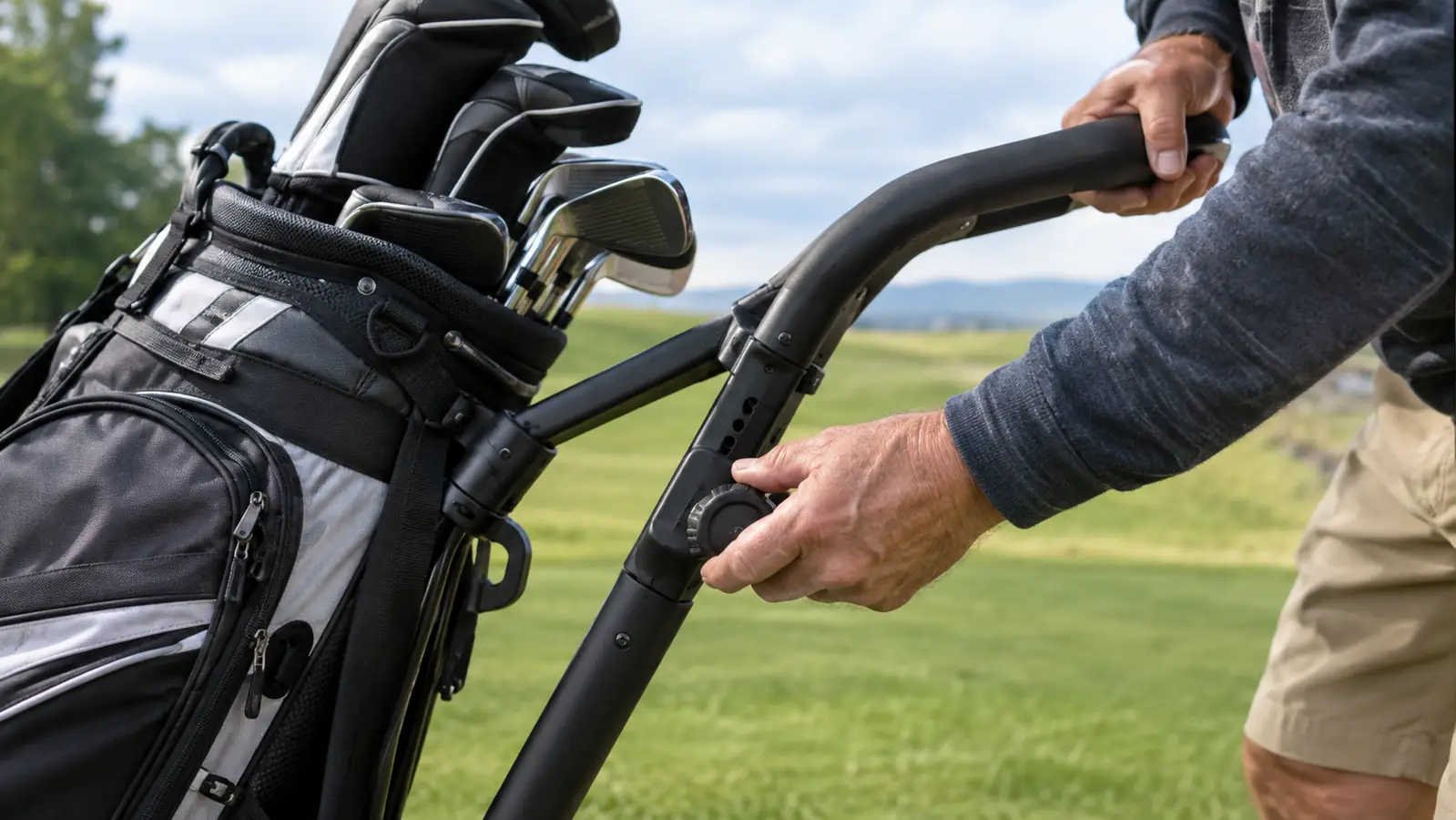
The first thing you notice about the Caddytek CaddyLite 11.5 V3 is the weight. At roughly 16.5 pounds, it is one of the lightest three-wheel carts I have picked up, and I have picked up a lot of them, in pro shops and in friends' trunks. For a guy my age who loads his own cart into a pickup bed before sunrise on a Tuesday, that matters more than any other spec on the page. I can lift it with one hand, drop it in the bed, and not think about it again until I get to the course. With a four-wheel cart, I always had to use both hands and a little bit of a heave, and on the mornings when my back was already stiff from working in the yard the day before, that heave was the worst part of my day before I ever hit a tee shot. The push is the part that surprised me. I expected a lighter cart to feel flimsy, like it would skate sideways on a slope or shimmy on the cart path. It does not. The EVA foam wheels roll smooth over packed dirt and asphalt, and the single front wheel tracks where you point it. On the flat front nine, I can push it with two fingers on the handle, which leaves my other hand free for a coffee or a rangefinder. The handle adjusts to a height that works for me, which is not a small thing when you are 6 foot 1 and most things are built for somebody shorter. I set it once in the parking lot and have not touched it since. The foot brake is the detail I use more than I expected. I can stop the cart with my foot while my hands are full, and it holds the cart still on a slope while I fish a ball out of my pocket.
The fold is the other big win, and it is the one I did not believe until I did it myself. The Caddytek quad-fold frame collapses into a package that fits behind the seat of a regular cab pickup or in the trunk of a sedan. I have thrown it in the back of my truck, in Karen's car when we take hers, and once in the back of a buddy's SUV on the way to a round. It just disappears. Four-wheel carts fold too, but they stay longer and bulkier, and they tend to live in the bed or the back seat rather than tucked out of the way. The first time I folded the Caddytek, I timed it out of habit, the way you do when you have spent 30 years in a shop. From standing upright to folded and in the bed of the truck was about 25 seconds, and that included cinching the strap. The four-wheel cart I borrowed took closer to a minute and still stuck out past the tailgate. On a course where I play twice a week, that minute of difference every round adds up to real time by the end of the season, and my back notices the lighter lift every single time. It also means the cart does not rattle around in the bed. I strap it down out of habit, but honestly it would be fine on its own.
Where Four-Wheel Carts Win
I will be straight with you: on a hilly course, a four-wheel cart feels more planted. My home course has a few side slopes that make a three-wheel cart feel tippy if you are not paying attention, and the worst one is the 14th, a par 4 that tilts hard left from the fairway down to a creek. The Caddytek handles it fine when you keep your hand on the handle and take the slope at an angle, but I have had the inside wheel come off the ground there once, on a dry August day when I was walking fast to keep up with the group. It did not tip, and I caught it without breaking stride, but it got my attention. A four-wheel cart on that same slope just sits there. You do not think about it. My buddy's cart, the one I borrowed, never once felt like it was going to go over, even when I parked it on the side of that same hill to walk ahead and look at my lie. If your course is genuinely hilly and you are not worried about lifting a heavier cart, that stability is worth something real, and I would not argue with anybody who picks a four-wheel cart for that reason alone.
Four-wheel carts also tend to have a lower center of gravity, which helps when you load them with a heavy stand bag. My buddy's cart holds his bag and a small cooler without complaint, and it never feels like it is going to tip on a rough patch of cart path. I loaded my bag, a cooler, and a rangefinder on it one afternoon, and it tracked straight and steady down a stretch of washboard gravel that made the Caddytek rattle. The tradeoff is that you feel that weight every time you lift it. The same cart that feels so steady on the 14th hill weighs somewhere in the mid-20s, and it does not fold down to anything near the size of the Caddytek. On the flat holes, which is most of my course, the four-wheel cart did not push any easier. It pushed a little heavier, actually, because there is more cart rolling under you. The stability shows up on the slopes, and the weight shows up everywhere. For a younger golfer with a strong back, that trade is easy. For me, it is the reason I stick with the Caddytek. I would rather take a slope a little carefully once a round than heave 25 pounds over the tailgate twice a round, every round, all season long. That is the honest trade, and it is the one the spec sheets do not tell you about.
Want the cart that disappears into your trunk?
The Caddytek CaddyLite 11.5 V3 folds small, weighs about 16.5 pounds, and has the storage pockets, foot brake, and drink holder built in. Check today's price on Amazon and see if it fits your routine.
Amazon Check Today's Price on Amazon →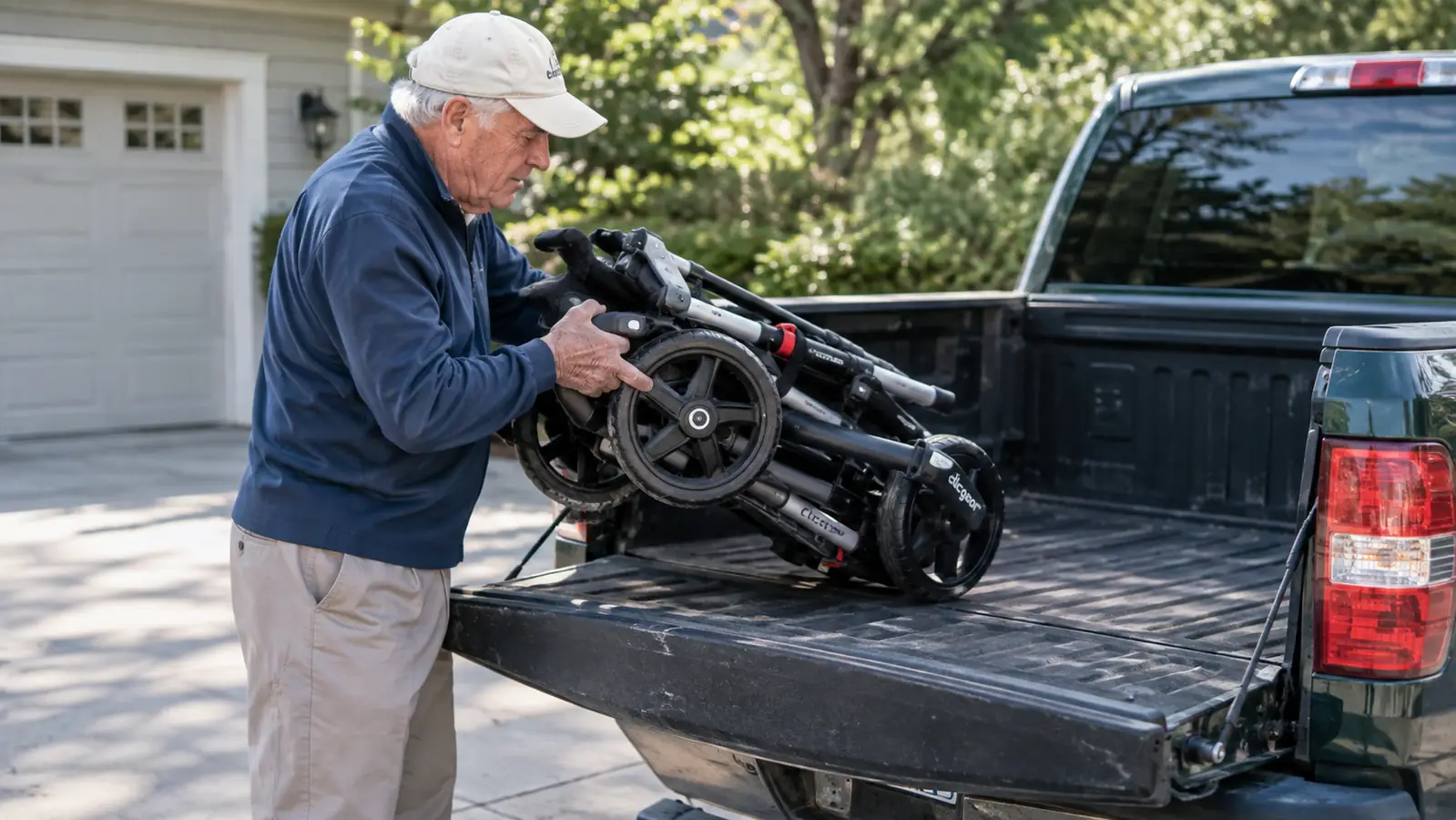
Who Should Buy Which
Buy the Caddytek CaddyLite 11.5 V3 if you load and unload your cart every round, if you drive a sedan or a smaller vehicle, or if your course is mostly flat with a few gentle hills. It is the cart I reach for every Tuesday, and it has held up through a full season of twice-weekly use. The foot brake is easy to use, even with a glove on, and it holds the cart still on a slope while you line up a putt. The mesh net holds my phone and keys, and the drink holder keeps a water bottle within reach on hot South Carolina afternoons, which is not a luxury, it is a necessity by August. I also like that the umbrella holder is built in. I play in the kind of sun where a round in July means I am looking for shade by the 12th hole, and being able to clip an umbrella to the cart instead of holding it is the difference between finishing the round and calling it early. One more thing that surprised me: the strap system holds my bag without sliding, even on the bumpy cart path behind the 5th green. I checked it the first few rounds out of habit, and it never moved more than an inch.
Buy a four-wheel cart if your course is hilly, if you want the most stable platform possible, or if you do not mind lifting 25 pounds every round. There is a reason they are popular with older golfers who play demanding courses, and I would not want to play a course like that every week without one. But for the money, the Caddytek does more for most weekend players. It is lighter, folds smaller, and costs less than most four-wheel carts I have seen. That is the honest math, and it is the math I ran before I bought mine. I am not the kind of golfer who buys the newest thing, and I did not buy the Caddytek because it was trendy. I bought it because it solved the two problems I actually had: my back and my truck bed. I tell the guys in my Tuesday group the same thing when they ask, and a couple of them have switched to three-wheel carts since, though one of them went back because his course is nothing but hills. That is exactly the point. It depends on your course and your back. If your problem is a sidehill course that makes you nervous, get the four wheels. Both are good carts. They are just good at different things.
Still weighing it? Start with the lighter cart.
The Caddytek CaddyLite 11.5 V3 is the cart I use every week, and it is the one I would buy again. See today's price on Amazon and decide for yourself.
Amazon Check Today's Price on Amazon →