

I carried my bag for two full seasons after I took up golf at 52, and my left shoulder filed a complaint around the 14th hole every single round. I tried a beat-up two-wheel pull cart from a yard sale, which folded up like a stubborn lawn chair and steered like a shopping cart with a bad wheel. Then one Tuesday, one of the guys in my group rolled past me with a three-wheel push cart that looked like it meant business, and I finally started shopping for one myself. I read reviews, pestered the regulars at the course, and settled on the Caddytek CaddyLite 11.5 V3.
Eight months later, it is still the first thing I load into the truck on golf days. I have pushed it over wet fairways, down cart-path-only hills, and through enough morning dew to rust a lesser cart. Here is the long version of what I think, including the parts that annoy me.
The Quick Verdict
A stable, easy-folding three-wheel cart that has taken everything my hilly home course has thrown at it for eight months. Not perfect, but I would buy it again tomorrow.
Amazon Check Today's Price →Tired of Carrying Your Bag by the 14th Hole?
The Caddytek CaddyLite 11.5 V3 is the cart I settled on after months of shopping, and it is still going strong. See today's price on Amazon and judge for yourself.
Amazon Check Today's Price on Amazon →How I've Used It
I play a public course in the Upstate of South Carolina, twice a week with the same Tuesday group plus a solo round most weekends. The course is hilly, with several holes where the cart path sits well below the green and a couple of long climbs between holes. That means the cart has to hold a full bag on a slope while I am standing downhill of it, and it has to roll straight on the path when I would rather be walking the fairway.
My bag is a stand bag on the heavier side because I carry too much in it. Rangefinder, rain hood, water bottle, a thermos in the side pocket, a change of socks in the ball pocket. I am the guy who is never short on anything except a decent drive. So the cart is doing real work, not just holding a feather-light Sunday bag.
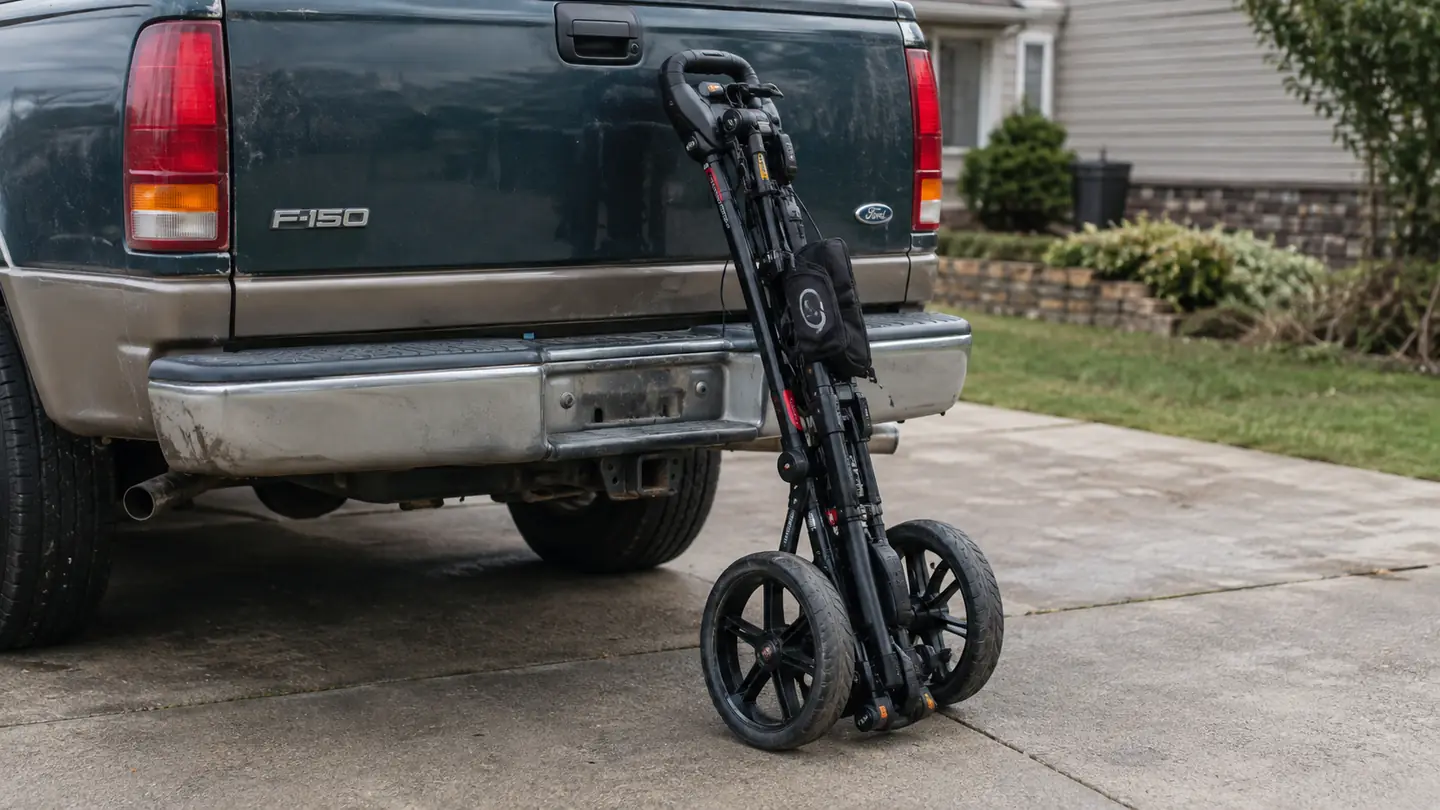
I fold and unfold the cart every single round, because it rides in the bed of my older pickup truck with the tailgate closed. That is the test that matters most to me: a cart that is a pain to fold gets left at home. In eight months, that is somewhere north of sixty rounds. The cart has been rained on, baked in July heat, and left in the truck bed overnight more times than I should admit. It has never once made me wish I had brought the other thing. The routine is the same every Tuesday. The cart goes in the bed first, then my bag, then the cooler. I have forgotten the cooler twice and the cart never.
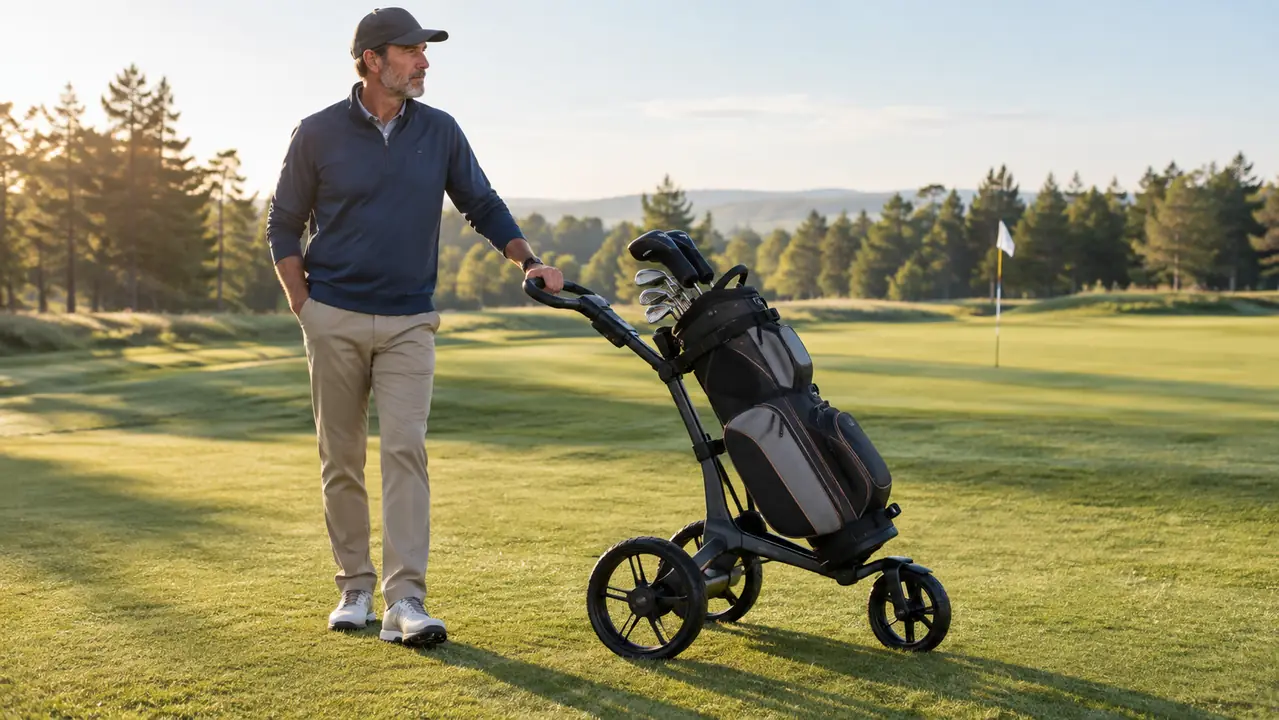
The Fold and the Weight
When I was shopping, the fold was the detail I cared about most. My truck bed has no liner and no tie-downs near the cab, so whatever I bring has to sit flat and stay put. The Caddytek has what they call a quad-fold frame, and it collapses into a compact bundle that I can pick up with one hand and slide behind the wheel well. It does not roll around on the way to the course, and it leaves room for the cooler and the push mower when I stop at the hardware store on the way home.
The cart is aluminum, and light enough that I do not dread lifting it. I am sixty-one, with the usual assortment of aches and a right knee that complains when I ask too much of it. I manage fine. Unfolding takes maybe ten seconds once you get the motion down. The first few times, I fought it, because you have to release a couple of latches in the right order and the front wheel wants to flop around while you work. Now it is muscle memory. Fold it, latch it, pick it up, done. I have had it down to a routine where I can have it out of the truck and ready before my playing partners have their shoes on.
One note on the latches: they are plastic, and they feel a little light for the job. Eight months in, mine are fine. But I am careful not to force them, and I would not be surprised if someone who slams the fold together eventually cracks one. Treat it like a piece of equipment that needs reasonable care, not a shovel you toss in the bed.
How It Handles on the Course
Here is where the CaddyLite earns its keep. The three wheels are EVA foam, so there is no air to check and no flats to fix. I have pushed it through wet rough, across gravel cart paths, and over the bare dirt patches that appear on my course every August. The wheels roll smooth and have not picked up a single puncture. The front wheel swivels for easy turning, and there is a small lever to lock it straight for stretches where the cart wants to wander on its own.
The foot brake is the feature I was most skeptical about, and it has won me over. It is a bar you step on to lock the rear wheels, and it holds the cart on a slope. I use it every time I stop to hit, especially on the hilly holes where the cart would otherwise roll into a bunker or down into the rough. It takes a firm step, and on wet grass I have to make sure it is fully engaged, but it has never let the cart run away on me. That is more than I can say for the yard-sale pull cart, which once rolled halfway down a hill with my driver in it.
Steering is predictable, which is what you want. The cart tracks straight when you push it straight, and it turns without fighting you. The first time I used it, I was waiting for the wheels to wobble or the frame to flex. They did not. The cart felt solid from the first push, which is not something I can say about the two-wheel pull cart it replaced. On sidehill lies, the bag wants to twist a little, which I will get to in a moment, but the cart itself stays planted. I have never had it tip, even on the steepest slope on the course, the one everyone calls Cardiac Hill.
The Small Details That Matter
A push cart lives or dies on the small stuff. The Caddytek comes with a drink holder that fits my insulated bottle, an umbrella holder that I used more than I expected during the July stretch, and a mesh net that I load with a light jacket and my golf glove. The handle adjusts to a few heights, which matters because I am tall and do not like to hunch. My wife Karen has walked along with me a few times and pushed it for a hole or two, and she did not have to stoop either.
The bag strap is a simple clamp that holds the bag by the handle and the base. It took me a couple of rounds to find the right position so the bag does not twist on slopes. The trick is to seat the bag deep into the cradle and tighten the clamp more than feels necessary. Once I got it set, I stopped thinking about it, which is the highest compliment I can pay a piece of golf equipment.
The drink holder deserves special mention because most of them are useless. Mine has held a full insulated bottle on every round, including the bumpy stretches, and it has not dumped a single drink. The umbrella holder is a simple tube that the umbrella slides into, and it has survived a windy afternoon without bending. The mesh net is the weak point, and I will get to that.
Eight months and north of sixty rounds in, the wheels still roll straight and the brake still holds on a slope. That is what I care about in a push cart.
What Has Worn Down After Eight Months
No honest review is complete without the wear and tear. Here is what I have noticed, in the order it happened.
The mesh net is the first thing to show age. The elastic cord around the edge has stretched, and the net sags a little when it is loaded. It still holds a jacket and a glove, but it is not as tidy as day one. I will replace the cord at some point, because the net itself is fine and the fix is a ten-minute job with a length of shock cord from the hardware store.
The brake mechanism needed a small adjustment around month five. A screw worked loose, and the brake would not catch cleanly. Ten minutes with a hex wrench fixed it, and it has been solid since. If you buy this cart, carry a hex wrench in your bag for the first few months and check that screw every so often. It is a two-minute habit that will save you a frustrating round.
The EVA wheels show scuffs but no wear that matters. The aluminum frame has a few small scratches from riding loose in the truck bed, which is my fault, not the cart's. The handle grip is still in good shape, and the latch that holds the fold together has not loosened. The little lever that locks the front wheel straight still clicks into place with the same authority as day one. None of this changes my recommendation. Every cart I have owned needed something eventually. The question is whether the cart earns its keep in the meantime, and this one does.
How It Compares to the Other Carts I Considered
I looked hard at a four-wheel cart before I bought this one, mostly because a buddy in my Tuesday group swears by his. Four wheels are steadier if you like to hang a heavy bag off the side, and some of them come with a little seat, which is nice on a slow day. But they fold up bigger, and the ones that fold small tend to cost more. For my truck bed and my back, the three-wheel Caddytek made more sense.
I also considered an electric cart. There are push carts with a motor on the front wheel that you steer with a remote, and they are genuinely great for people with bad knees or a bad back. They are also heavy, more expensive, and another battery to keep charged. For me, that is more machine than I need. I am not the target for that, and I know it.
The Caddytek sits in the middle: lighter and more affordable than the motorized carts, and easier to live with than most four-wheelers. It is not the fanciest cart on the course, and it does not have a seat or a cooler or a place to charge your phone. What it does, it does every single round, without drama. There is a lot to be said for that.
What I Liked
- Folds small enough to live in a truck bed or trunk, and unfolds in about ten seconds
- EVA wheels never go flat and roll smoothly over wet grass and gravel
- Foot brake holds the cart on a slope, which my home course demands every round
- Drink holder, umbrella holder, and mesh net are all genuinely useful
- Aluminum frame is light enough for a sixty-one-year-old to lift without drama
- Has survived more than sixty rounds of rain, heat, and truck-bed abuse
Where It Falls Short
- Mesh net elastic stretches over time and needs replacing
- Brake screw worked loose around month five, an easy fix but worth watching
- Plastic latches feel lighter than the rest of the cart
- Bag strap takes a few rounds to position so the bag does not twist on slopes
- No built-in storage for keys or wallet, you still need a pocket or a pouch
Who This Is For
If you walk your home course, this cart is worth a serious look. It is for the golfer who is tired of carrying a bag by the back nine, who wants to walk more and ride less, and who does not want to overspend to do it. It is for the person who keeps a cart in the trunk or the truck bed and wants something light enough to lift without a second thought.
It is also for anyone with a hilly course. The foot brake alone is worth it on my course, and I would not go back to a cart that cannot hold a slope. And it is for the golfer who wants a cart that does not need a manual, a tool kit, or a degree to operate. You unfold it, you push it, you fold it, you go home.
Who Should Skip It
If you ride in a cart every round and only walk a few times a year, you do not need this. If you want a cart with a seat so you can sit at the tee box, look at a four-wheel model. If you have serious mobility problems and need a motor to do the pushing, an electric cart is the honest answer, and no amount of lightweight aluminum changes that. There is no shame in any of those choices. I have friends who ride every round and friends who spent more on a motorized cart than I spent on my first set of clubs. The Caddytek is for the walker who wants a simple, dependable push cart, full stop.
I would also say: if you are the kind of golfer who wants every pocket and accessory built in, the Caddytek will leave you wanting. It is a straightforward cart with the basics done well. That is exactly why I like it, but I know golfers who want more, and there is nothing wrong with that.
The Cart I Keep Loading Into the Truck
After eight months and more than sixty rounds, the Caddytek CaddyLite 11.5 V3 is still the first thing in the bed on golf days. If you walk your course, it deserves a look. See today's price on Amazon.
Amazon Check Today's Price on Amazon →