
I spent the first five years after I took up golf guessing. I would stand over the ball, squint at the flag, and think, that looks like a 7 iron. Sometimes it was. A lot of times it was a 6, or a 5, or a 9, and the ball would end up short, long, or in a bunker I did not even know was in play. My Tuesday group got used to me walking up, dropping a ball, and saying, well, that was the wrong club. Then I bought a Callaway 300 Pro laser rangefinder, and the guessing stopped. This is how I use it to pick a club, and how you can too.
A rangefinder does not swing the club for you. It does not fix a slice or make a 20-foot putt. What it does is take one variable off the table: the distance. And for a mid-handicap player like me, distance is the variable I was worst at judging. Here is the process I have settled on after two seasons with the Callaway 300 Pro, step by step.
Stop Guessing the Yardage
The Callaway 300 Pro gives you a precise number in about a second, with slope readings when you want them and a simple switch to turn slope off for practice rounds. It is the rangefinder I keep in my bag every Tuesday.
Amazon Check Today's Price on Amazon →Step 1: Get a Number You Can Trust
The whole method starts with one clean number. I point the Callaway 300 Pro at the flag, hold it steady, and wait for the readout. On a normal shot that takes about a second. The unit locks onto the pin and shows the yardage, and that is the number I build the rest of the shot around.
The trick is to aim at something specific. The flag is the obvious target, but on a bright day a flag can be hard to lock. I have learned to aim at the base of the pin, or at the flagstick itself, and to brace the rangefinder against something solid when I can. Leaning against the bag or tucking my elbow into my ribs cuts the shake way down. If I get a reading that seems off, I just shoot it again. Two seconds of rechecking beats a lost ball.
One thing I will say plainly: the Callaway 300 Pro has never given me a number that did not match the course markers. The yardage on the sprinkler heads and the yardage on the rangefinder agree, and when they disagree, the rangefinder is the one I trust, because it is measuring to the pin, not to the front of the green. Last fall I checked it against the 150-yard stake on our par 3 third hole, a hole I play twice a week, and it read 152 to the pin on a day the flag was sitting at the back. That is the kind of detail that made me trust the unit.
Step 2: Know What the Number Means
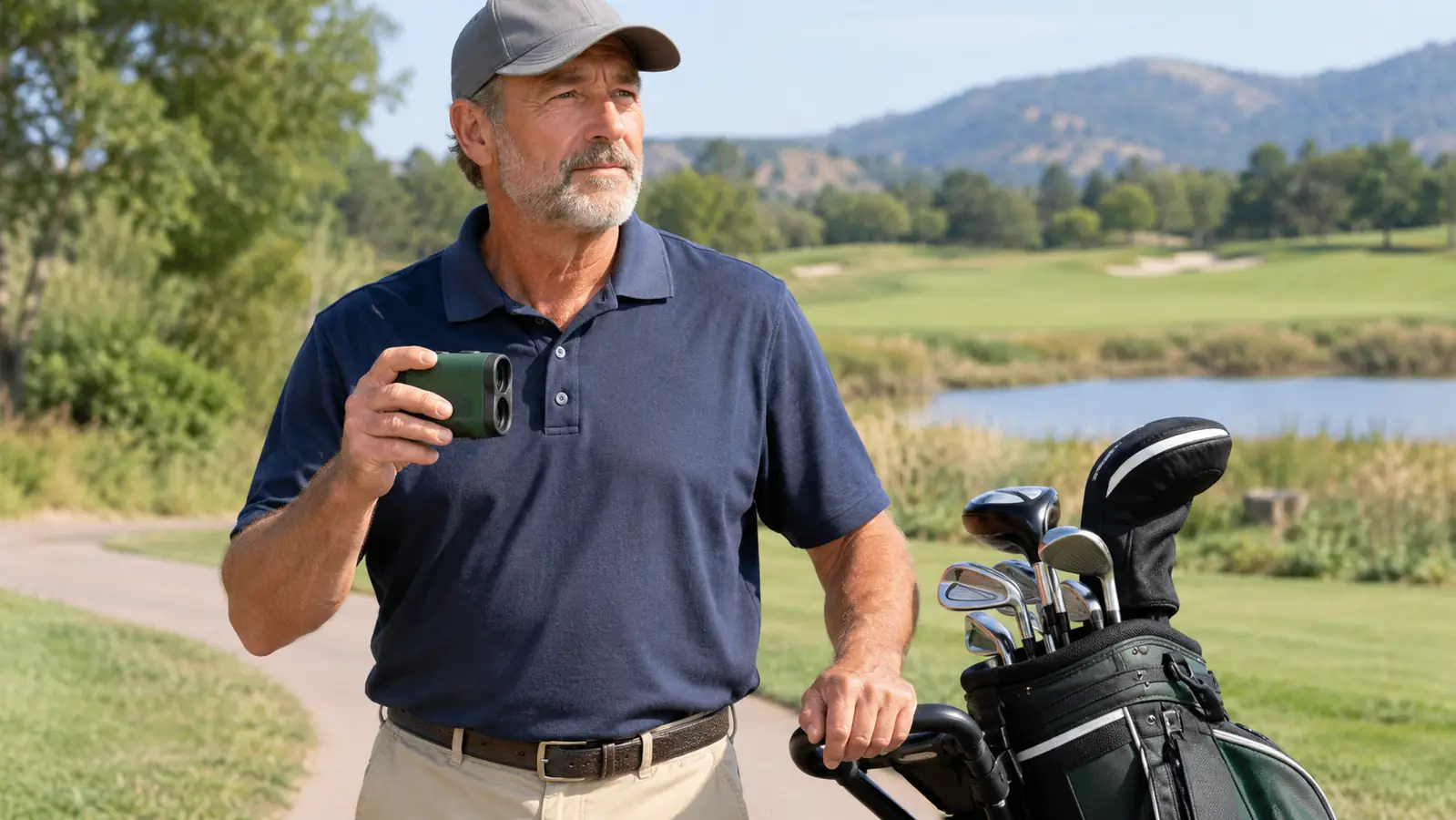
The number in the viewfinder is the distance to the flag, in a straight line. That is not always the distance the ball will travel. If the shot is uphill, the ball has to cover more ground. If it is downhill, it covers less. If there is wind in your face, the ball will come up short. If the wind is at your back, it will run out.
This is where the slope switch on the Callaway 300 Pro earns its keep. Flip it on, and the unit gives you the adjusted yardage, the number that accounts for the uphill or downhill. I use slope on the course all the time, because my home course is hilly and the difference between a flat 150 and an uphill 150 is a full club for me. On the 11th hole, a par 4 that plays uphill the whole way, the slope reading routinely gives me 8 to 10 extra yards, and that is the difference between my 5 iron and my 6.
The honest caveat: slope is not legal in tournament play, and it is not legal in a lot of league play either. The Callaway 300 Pro has an external switch, so I can turn it off and know the unit is compliant. For a casual round with my Tuesday group, I leave it on. For anything that matters, I flip it off. That switch is the reason I picked this model over one without it.
Step 3: Add Your Own Numbers
A rangefinder tells you the distance. It does not tell you which club. That part is on you, and the only way to know it is to hit a lot of balls and write down what happens. I keep a small notebook in my bag, and after every range session I jot down my average carry for each club. Not my best shot, my average. The 7 iron that goes 150 once in a while is not a 150 club if it usually goes 140.
Here is the system I use. On the range, I hit five balls with each club, ignore the best and the worst, and take the middle three. That gives me a number I can actually plan around. My 8 iron carries about 135, my 7 about 145, my 6 about 155. Those are my numbers, and they are probably not your numbers. That is the point. The rangefinder gives you the distance, and your notebook gives you the club. I started this in March of last year, and by June the numbers had stopped moving around, which told me I finally had a repeatable swing.
I also write down the lie. A ball sitting up in the fairway plays one way. A ball in the rough plays another. A ball on a downhill lie plays shorter. The more I note about the conditions, the better my club choice gets, and the less I have to rely on the memory of a 61-year-old shop teacher. I write the lie in the margin, one word, so I can look back and see that my 7 iron carries 145 off a good lie but only 135 out of the first cut.
Step 4: Build a Simple Rule for the Shot
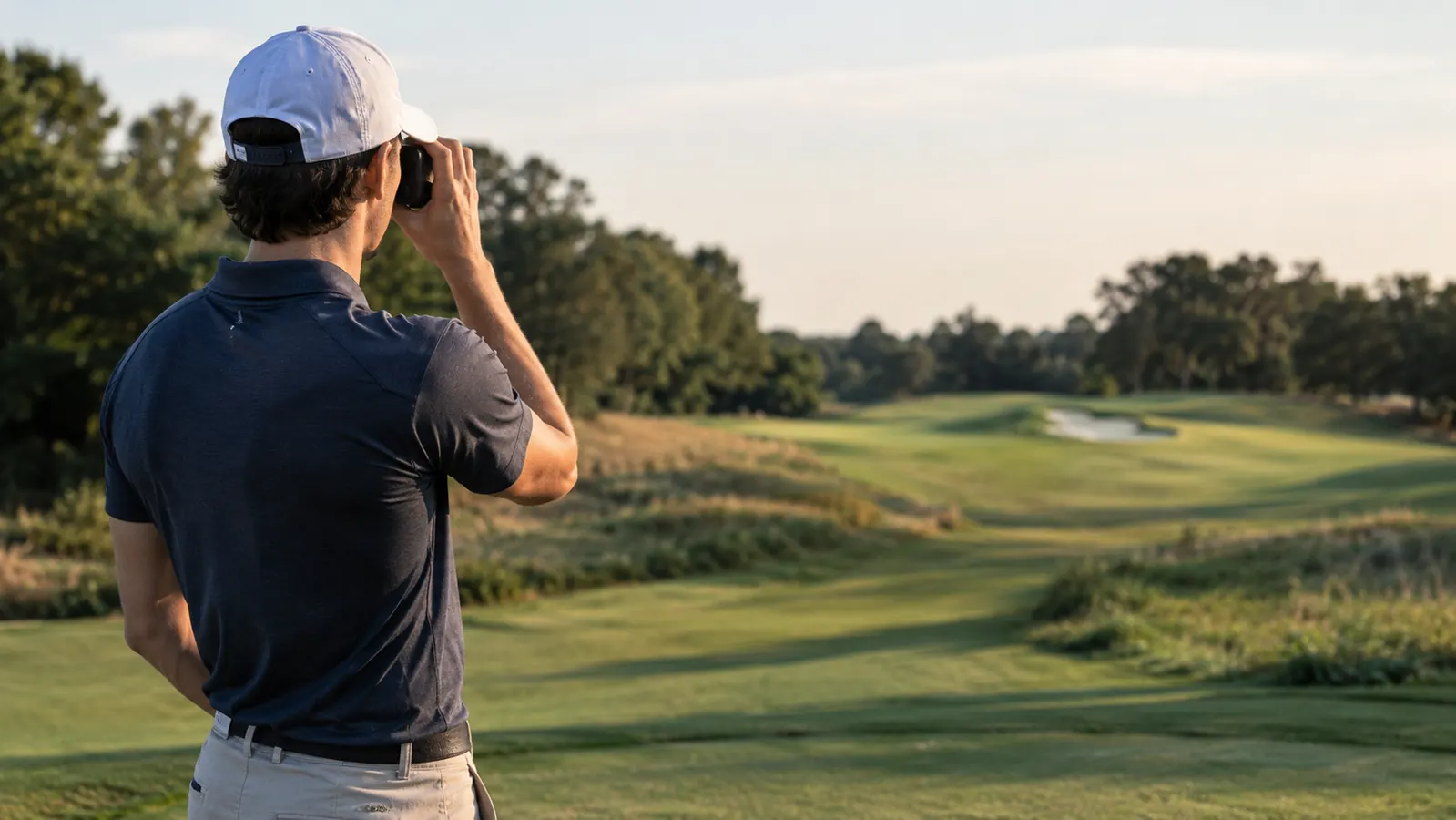
Once I have the distance and my own numbers, I do the math in my head. It is not complicated. If the rangefinder says 150 and my 7 iron carries 145, I hit the 7 and swing easy, or I hit the 6 and swing smooth. I would rather be a little long than a little short, because short means the bunker and long means the fringe. That is my rule, and it has saved me more strokes than any swing tip I have ever read.
The other part of the rule is knowing when to lay up. A rangefinder is great for measuring a hero shot over the water, and it is also great for telling you that the hero shot is 215 yards over water, which is a stupid shot for an 18-handicap. I use the Callaway 300 Pro to talk myself out of trouble as much as into it. If the number says the smart play is a 7 iron to the fat part of the fairway, I hit the 7 iron. On the 16th hole at my course, the water cuts across at about 200 yards, and the rangefinder has talked me out of going for it more times than I can count.
I will be straight with you: the rangefinder did not lower my score the first week. It lowered my score the first month, once I stopped aiming at flags I could not reach and started aiming at the part of the green I could actually hit. That is the real value of a number. It tells you the truth about your game.
Step 5: Use It on Every Shot, Not Just the Hard Ones
The mistake I see with new rangefinder owners is that they pull it out for the long par 5s and leave it in the bag for the easy 100-yard shot. That is backwards. The easy shots are where the strokes are. A 100-yard shot with the wrong club is still a bogey, and a 100-yard shot with the right club is a real look at par.
So I shoot the flag on every hole, even the ones I have played a hundred times. The wind changes, the pin moves, the tees move, and my swing changes from one Tuesday to the next. The Callaway 300 Pro takes about a second to use, and a second of certainty is worth more than a minute of guessing. I also use it on the range, to check the distance to the targets, so the numbers in my notebook stay honest. The range at our course has markers at 100, 150, and 200, and I have found the 150 marker is really 147 on the left side, which matters when I am practicing my 7 iron.
The habit part matters more than the hardware. A rangefinder is only as good as the routine around it. Shoot the flag, check the slope, add your own number, pick the club, commit. I have done that routine on every shot for two seasons now, and I can tell you the difference between guessing and knowing is the difference between hoping the ball lands near the green and watching it land on the green.
What Else Helps
A rangefinder is the biggest upgrade I have made to my game since I started, but it is not the only thing in the bag. A few other tools have earned their place. A GPS watch is a nice backup, because it gives you front, middle, and back yardages at a glance, though I still prefer the rangefinder for the exact pin number. A good pair of golf shoes keeps me stable in the wet Upstate mornings. And a notebook, the cheap kind from the drugstore, is the best training aid I own, because it forces me to pay attention to what I am actually doing.
The other thing that helps is playing with people who are better than you. My Tuesday group has a couple of guys who have been playing since they were kids, and they have taught me more about course management than any book. They also tease me about the rangefinder, right up until the moment I hit the green from 150 and they are in the bunker. Then they ask to borrow it.
The difference between guessing and knowing is the difference between hoping the ball lands near the green and watching it land on the green.
The Rangefinder I Reach For Every Round
If you are tired of guessing yardages and want a rangefinder that is simple to use, accurate, and has a slope switch you can actually turn off, the Callaway 300 Pro is the one I keep in my bag. It has made my Tuesday rounds more fun, and that is worth the price of admission by itself.
Amazon Check Today's Price on Amazon →